Showing posts with label Brendan Byrne Arena. Show all posts

Monday, March 22, 2010

A City Best Seen With A Map

Originally written February 17, 2010

As a child I never dealt with the trouble that comes from moving. I know many people who did and I can’t imagine having to restart my life and develop a new circle of friends. Had I not lived in the same house my parents bought in 1981 for my entire pre (and part of my post) college life, I would be completely different. Of course, it’s entirely possible I would be more able to deal with transition, which might have served me well when the Devils moved into their new home in October of 2007.

Now, this wasn’t quite the same change as when the Mets jumped across the parking lot to Citi Field 18 months later. I had spent far more time at Shea Stadium than Brendan Byrne Arena. But something still seemed odd about the opening of the Prudential Center. Perhaps it was because it was the first sporting venue in the New York Metropolitan area to open since the Byrne, which, interestingly, also opened its doors for the first time in 1981.

Perhaps it was only right that the first one of my teams to change its venue – three of them would over the next three years – came just months before I moved out of my childhood home for good, to the 21st-floor apartment I currently call home in Long Island City, Queens.

While in college I had paid a fair amount of attention to the Devils’ new arena – the planning, the spending, the groundbreaking. It would be tough in some ways to bid the Byrne its farewell. Despite watching the Devils lose the first time I went there, I had gone on a remarkable run over its final years. My mother and I witnessed Vancouver’s Todd Bertuzzi beat Martin Brodeur 56 seconds into overtime to hand the Devils a 3-2 loss to the Canucks on December 4, 2002. That would be the last time I ever saw the Devils lose at there. In fact, I wouldn’t see them lose in person again until a 4-1 loss to Buffalo on October 28, 2009 – their third season at Prudential Center.


Still, the Byrne had several flaws. It was a dull building far from any public transportation, which meant going there without your parents was impossible until you had a driver’s license. In New Jersey that didn’t happen until your 17th birthday. While I was a licensed driver by the opening of the Prudential Center – or as it would quickly be nicknamed in a nod to Prudential’s corporate logo: “The Rock” – there was still a joy that came with public transit. Moreover, the Devils simply needed a new home. The Byrne had become outmoded, difficult to get to and did not provide the revenue streams that many newer buildings gave their teams. The Devils had been clamoring for a new building for more than a decade by the time it opened, including a tenuous moment when the franchise nearly moved to Nashville immediately following its first Stanley Cup in 1995.


After years of back-and-forth, however, the Devils had finally found their home in the Rock, a beautiful, if poorly attended building in the Ironbound District of downtown Newark. To many, the choice of Newark, a downtrodden and poorer city was an odd choice for a hockey team to call home. Many feared the dangerous neighborhoods nearby and ESPN hockey commentator Barry Melrose joked, “Don’t go outside, especially if you’ve got a wallet or anything else because the area around the building is awful”.

Not surprisingly, Melrose’s comments struck a chord with the team, the fans and Newark Mayor Cory Booker. After all, the Rock was expected to be the anchor that revitalized a dying, crime-ridden city, and after Melrose agreed to come to Newark and see the building and the surrounding neighborhood for himself he changed his tune despite a derisive greeting from the crowds. Whether he did so out of honesty or contrition is immaterial. All I can say is when I first made my way there on November 2, 2007, the hefty police presence made me feels as if I was hardly in danger. I would find my own way to put my life at risk just hours later.

At the time I was three weeks into my new job and I decided to get tickets through work for my first venture to the Devils’ new lair. On my way to the game I parked my car outside my father’s house in Maplewood, New Jersey, a few blocks from the train station. As I lived at home for nearly a year after college despite working, parking at my dad’s house and walking to the train was something I had down to a science by the time I moved.

Usually, my father was working when I went to the office, but this time he was home so I decided to stop in and say hello. In retrospect, this may have been a poor choice as once I told him I was going to the Devils game with the company tickets his eyes lit up in anticipation that I was surprising him with a gift. After I informed him that I was actually going to the game with my friends Feiny and Justin, his expression changed considerably.

Oops.

I met Feiny on the train – Justin would be arriving later and, as the plan went, buying an upper deck seat and sneaking down to wherever our seats were. The public transit options were a bit untested for both of us and with this being only the Devils’ third game at the Rock not many people knew how it worked. Supposedly the public transit options involved going to one of the two train stations in the city of Newark, either Newark-Penn Station or Newark-Broad Street Station. At Penn Station it was easy enough, the platform was a brief two-block walk from the building. Broad Street, the station we were going to, was a further distance, but the Devils ran free shuttles to the Arena and as we found when we got off the train, there were dozens of employees ready and willing to direct you. As it turned out, getting to the building was as easy as could be.

As we approached the Rock it was infinitely nicer than Brendan Byrne Arena. While the Byrne was a boring, soulless box, Prudential Center had an inspired design that gave character and life to New Jersey’s hockey home. The walls were covered in red brick with dark gray borders encapsulating them, echoing the Devils’ color scheme and, supposedly, paying homage to the industrial bricklaying and railroad heritage of Newark, which is also known as “Brick City”. The front of the building featured a massive LED screen while two of its corners were made of massive glass light towers, which fans entered through as escalators led them to the main concourse. From the outside on game nights, the Rock brims with light and energy, an attempt to breathe life into a city that had been beaten down by decades of crime and poverty.

Newark had been a bustling metropolis for much of the early 20th century, with its population reaching nearly half a million in 1950. But racial tensions and eventually several days of riots in 1967 damaged much of the city and hastened its decline in population, wealth and stature. By the time the Rock opened, Newark’s population stood at nearly half of what it had at its peak. As Booker and others led the long drive back to respectability, this arena and the area surrounding it were central to the Brick City’s rehabilitation.

That is not to say that it was without its decent areas. Newark’s downtown business district was a perfectly safe place to spend your days toiling and the Ironbound district had its share of decent restaurants. My high school graduation was followed by dinner at a Portuguese rodizio restaurant in Newark called Seabra’s. But those decent areas couldn’t spare the city its reputation. In 1996, TIME Magazine dubbed Newark “The Most Dangerous City in America”, and while the ranking had dropped to a still reasonably robust 20th when the Rock opened, Newark’s reputation continued to precede it.

If its downtrodden areas were what Newark was, Prudential Center’s glitzy exterior and its clean interior were what it wanted to be. The inside of the building features far more character and decoration than the Byrne ever did. Murals detailing the Devils’ history, as well as homages to Newark and New Jersey’s sports history grace several walls along the main concourse. When the building opened, one section featured two huge banners with paintings of each building the franchise had played in from its early days in Kansas City as the Scouts, to its brief stay in Denver as the Colorado Rockies and both of its arenas in the Garden State.

One exhibit featured all of the jerseys the Devils had worn throughout their history, and another wall was painted with a bench featuring the Devils’ greatest all time players, among them Craig Billington, Bruce Driver, John MacLean, Slava Fetisov, Claude Lemieux, Scott Stevens, Scott Niedermayer, Ken Daneyko and, of course, Martin Brodeur. Echoing a trend started by the Minnesota Wild, the interior of the arena on both levels is lined with the jerseys of every high school hockey team in the state in an attempt to draw a closer connection between New Jersey’s team and its residents.

Lastly, and perhaps most interestingly, the tops of each urinal in the men’s room has an all-too-necessary Devils logo on top of it.

The building didn’t just raise the experience – or the cost – for the fans. It was also a one-stop location for the organization, featuring office space as well as the Devils’ practice rink. The Rock was only the second building in the League to house one after Nationwide Arena in Columbus, and while there is a huge glass window that allows fans to look in on the rink during practice, this was another sign for me that I was getting older. I had more than once dragged my father to South Mountain Arena in West Orange, New Jersey, a short drive from my home to watch the Devils practice. Still, with the advantages for the team, I’d find a way to get over it. Just about everything in the Prudential Center was a dramatic improvement over the Byrne.

Feiny and I were hoping our seats would be in the building’s two All-You-Can-Eat Sections. From blue line to blue line, the lower bowl sections featured large leather seats and were attached to two bars, cleverly called the “Fire” and “Ice” bars, which featured free all you could eat food and non-alcoholic beverage. While during the games it was typical arena fair – burgers, hot dogs, pizza, chicken fingers – before the games multiple carving stations were set up with finer choices like prime rib and duck. For those not fortunate enough to score those tickets, other food options around the arena still feature various types of cuisine with many coming from the city of Newark itself.

Unfortunately, while I had gotten nice seats, they were in the section over from the free food. After Justin arrived and somehow weaseled his way to our section, he and Feiny decided it was only right to sneak into the fire bar and grab some food. I was gun shy about raising trouble and reluctantly left them to their own devices while I sat and watched the game. I assumed their efforts would be fruitless, but sure enough the pair returned to our seats 15 minutes later with a slice of pizza for me.

I found it a bit of meaningful symmetry that I would see the Devils face the Maple Leafs in my first game at the Rock as I had 12 years earlier for my first game at the Byrne. In a lucky change of fate, however, the result was different this time around. While the Leafs controlled play for much of the first two periods, outshooting New Jersey 20-9, the Devils somehow managed to keep it tied before John Madden potted a shorthanded goal with 4:12 left to play to break a 1-1 stalemate. Zach Parise would add another 97 seconds later and the Devils had a 3-2 win in my first visit to their new home.

The streak would remain intact for another night.

While I was convinced the action was over for the night, I would find myself in for a surprise. With a rare Friday night off, my original plan was to continue on to New York and spend the night drinking with friends. Feiny, Justin and I,were unable to find the shuttle back to Newark-Broad Street station, however. The next time I came I would wonder how on earth I missed it. It was in the exact same place we were dropped off beforehand. But rather than stand there and wait for a second shuttle to arrive, we decided to expedite the process by simply walking to the train.

After all, how far could it be?

And so off we went through downtown Newark, which seemed perfectly fine on a Friday night. Crowds who were leaving the game or their offices still surrounded us and we headed on with impunity. As we continued the surroundings started to get somewhat less pleasant, but we assumed the station must only be a few blocks away. At one point we happened upon a theater with a long line of people in their early to mid-20s waiting outside. Justin, never one to pay social awkwardness any mind, suggested we run across the street and check out the show. While Feiny was amenable to the idea, I was not and insisted we continued walking.

Justin, however, has a tendency to be a free spirit and so off he went to see what was happening. This being the heart of downtown Newark, the crowd outside the theater was entirely African-American. In fact, there wasn’t a non-black person among them. While I detest bigotry, there was no denying that we would seem at least a little out of place. Between the three of us, our collective heritage was 83.3% Caucasian Jew and 16.7% Indian. We did not fit in, and the stunned reaction of the entire crowd when Justin nonchalantly asked them what was happening at the theater let us know it.

All of them gave us a look as if they had no clue what we were doing in the heart of Newark on a Friday night. After all, I was wearing cargo pants, Birkenstocks and a purple Northwestern hooded sweatshirt. It was clear to them I did not belong. Justin continued to press for details about whatever concert was about to be performed, but I refused to play along and started walking. As we continued it started becoming apparent that the train wasn’t as close as it seemed.

The walk continued, the lights got dimmer, the surroundings got darker and more and more broken glass appeared on the ground. More and more people on the street were asking for money and the buildings became more rundown. It was about the time the malnourished prostitute with several missing teeth offered her services to us that I realized we were lost in one of the most dangerous cities in America.

I started walking faster.

Justin and Feiny, in their absentmindedness couldn’t enjoy the light evening stroll enough. They spent most of the walk laughing, but I decided I was done aimlessly wandering the lesser parts of Newark. When we finally happened upon an onramp for I-78, we knew we were far from the right place. We soon found ourselves in a convenience store where the clerks were unable to provide adequate directions.

We walked further and I called my mother to see if she could find a map online to tell us where the train station was. Fearing for the life of her child as mothers often do – although perhaps this time it was rational – she insisted she come and pick us up, but being an adult who dreaded the idea of his mommy coming to the rescue, I rebuffed her offer and insisted we’d find our way back. Eventually, our clueless triumvirate found its way to a McDonald’s on McCarter Highway, where I asked the security guard – apparently McDonald’s in Newark requires protection – how to get to either of Newark’s main train stations.

We were, in fact, nowhere near either of them and unwilling to undertake the long trip to wherever it was we needed to go, I called mommy to rescue me. After looking up where we were and how to get there, my mother was on her way.

The three of us sat down in a booth and took deep sighs of relief. I was badly in need of comfort food so I went to the counter and ordered a vanilla sundae. A few minutes later the manager let me know that the machine which pumped out whatever it was they thought was ice cream was actually broken.

Of course it was.

As I sat back down with what I thought was my last defeat of the evening, Justin reached into his backpack and pulled out a crumpled piece of paper. After unraveling it he noticed it was a color-coded map of Newark which had been given to him by Devils personnel at the train station. Not only did Justin have a map on him the entire time that would have easily directed us to the station, but we had wound up walking some three miles in the complete opposite direction.

At this point all I could do was laugh at what had been a long comedy of errors. Soon my mother was there and we were back in Millburn with no harm done. The three of us headed to Justin’s home where we spent the next few hours laughing about the misfortune over a six-pack of Yeungling and all the leftover Halloween candy the Goldstein household had to offer.

I may have risked my life at various points in the evening, but all in all, good friends, good beer and a pile of Reese’s Peanut Butter Cups wasn’t a bad way to spend a Friday night. With my memories in tow, however, I would never spend one the same way again.

The next time, I waited for the shuttle.

Tuesday, March 2, 2010

Making A Bad Decision

 Originally written April 19, 2009

The dull box of Brendan Byrne Arena has played a much larger role in my youth as the first home of my New Jersey Devils, and likewise Madison Square Garden for the New York Rangers, but remarkably enough, I had actually made my first visit to the Byrne a month before that fateful loss to Toronto, when I went to see the Devils’ co-tentants, the New Jersey Nets. My first professional basketball game was on November 11, 1995. That morning I was playing in a pee wee football game in Summit, New Jersey, when a parent of one of my teammates offered my father their tickets for that night. I had never been to an NBA game before, so I was fairly excited, but despite that, I remember shockingly little about the game itself.

The Nets were playing the Sacramento Kings, this much I recall, and the Nets won by an 86-84 score as the Kings fired up a three-point shot at the buzzer that bounced off the rim. The more impressionable aspect, however, was the horrific weather that night. The Meadowlands of northern New Jersey are a large flat area where wind can pick up and wreak havoc, which has often been an element of difficulty for punters when the Giants and Jets play across the parking lot. On that particular night, when there was a massive thunderstorm, my father, my friend Matt Nedostup and I sprinted from the arena to our car, at one point on the trip seeking refuge behind a parked 18-wheeler as a break from the swirling winds. By the time we were once again under a roof we were completely soaked.

Much of the in-game experience that night is a total mystery to me. What I remember of the arena itself has long been pounded into my head by my many trips there to see the Devils, and the inside feels fairly similar except the center of the action is wood rather than ice. I’ve only been to a handful of Nets games in my life, though a game in 2003 between the Nets and Pistons does come to mind. The Nets were a double casualty of both only a scant interest in the NBA in my childhood and the fact that when I finally did get sucked into professional basketball, it would be the Knicks that I’d call my team.

This was a bad decision.
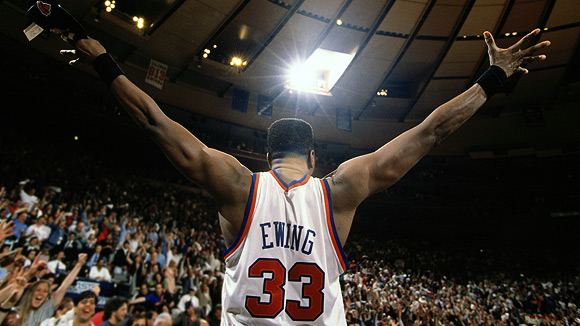
I first paid attention to the Knicks in 1994 during their seven-game loss in the NBA Finals to Hakeem Olajuwon and the Houston Rockets. I rooted for them and remember watching Patrick Ewing standing on the scorer’s table and soaking in the cheers after defeating the Indiana Pacers for the Eastern Conference title that year. But I also liked Michael Jordan and the Bulls. How could you not? I wasn’t the most enthusiastic follower -- really I was mostly a fan of the legendary NBA on NBC theme music -- and didn’t really settle myself as a fan of a particular team until 1999. The first half of that season had been cut short by a lockout, one of many monetary squabbles between two different sets of rich men that rarely get any sympathy or understanding from the public.

In reality, collective bargaining agreements do broach a number of serious issues and determining how to divide the pain is no small matter.

But we’re fans. We don’t care. We want to watch our games.


By the time the playoffs rolled around for the shortened campaign, the Knicks snuck in as the No. 8 seed, and did so as a fairly different group from the one that made the finals five years earlier. John Starks was gone in favor of the energetic and controversial Latrell Sprewell, likely the biggest difference between the two teams. Sprewell was so deemed controversial because in December 1997 he had been told by P.J. Carlesimo, his coach with the Golden State Warriors, that he needed to “put a little mustard” on his passes.

Sprewell responded by choking Carlesimo.

Sprewell wouldn’t play again for 14 months until the Warriors dealt him to the Knicks at the start of the shortened 1999 season. With Spree, a self-described changed man, providing energy off the bench while Larry Johnson and Allan Houston created from the perimeter, the Knicks stunned the NBA with a remarkable postseason run that saw them get past the top-seeded Heat on a late runner by Houston in Game 5. New York was only the second No. 8 to advance to the second round, after the 1994 Denver Nuggets, but they would be the first to reach the conference finals after a sweep of the No. 4-seeded Atlanta Hawks.

One round later against the infinitely clutch Reggie Miller and the hated Pacers, the Knicks would become the first No. 8 to reach the NBA Finals in a dramatic six-game series that featured Larry Johnson’s miracle four-point play in Game 3 and forever cemented Sprewell’s place in the hearts of Knicks fans. The Knicks would fall in five games to a vastly superior Spurs team that featured the almost unbeatable frontcourt of Tim Duncan and David Robinson, but my mind was made up.

This was my team. I was a Knicks fan.

For the next decade I would wonder how I could have gone so wrong. While the local Nets would trade for future Hall of Fame point guard Jason Kidd, who led them to two straight Finals appearances in 2002 and 2003, the Knicks would wallow in mediocrity until hiring Isiah Thomas to be team President in 2003, a move with longterm consequences so far reaching and so disastrous that by the time he was forced out in 2008, New Yorkers were wishing they were merely wallowing in mediocrity again.

To recount Thomas’ myriad mistakes and poor decisions is an interminably frustrating exercise in masochism. During his tenure, Thomas traded for former Coney Island phenom Stephon Marbury, a man with a long history of being a difficult ball hog as well as a locker room cancer. Marbury’s greatest accomplishment as a Knick might have been providing comic fodder during a sexual harassment lawsuit against Thomas and the front office when he admitted on the stand that he had lured an intern into his truck for sex. Not to be outdone, Thomas also traded two unprotected first-round draft picks to the Chicago Bulls for Eddy Curry, a vastly disappointing high draft pick with a known heart condition. When asked about how Curry could improve his rebounding once, his former coach Scott Skiles said, “Jump.” One wonders how difficult it was for Bulls GM John Paxson to hide his laughter when Thomas first called up to offer the deal.

The Knicks would be horrendously bad during Thomas’ tenure, and moves to add Zach Randolph and sign Jerome James to a five-year $30 million deal only compounded the pain. James is often forgotten when recounting Thomas’ mistakes, but he may supplant Curry as the most awful. James would only play 90 games for the Knicks in three and a half seasons while averaging a whopping 7.72 minutes per game. At one game I attended against the Milwaukee Bucks, the Knicks were being thoroughly handled when James finally made his first appearance late in the fourth quarter. Much of the depleted crowd cheered wildly whenever he touched the ball and completely erupted in cruel mockery when he actually score a basket.

As one fan yelled from behind me during the next possession, “Give it to Jerome! He’s got the hot hand!”

At another game against the Cleveland Cavaliers in 2007, my friend Bert and I attended fully prepared with grocery bags to wear over our heads. Unfortunately, that night was one of those rare instances when the Knicks actually defeated a team vastly superior to themselves, but we still took a picture for our records, and were asked to pose with the bags on for a photo by some visiting Cavs fans to boot.

While my first Knicks game came after their inspiring run to the 1999 Finals, it was actually before the Thomas Circus did everything short of literally burn down Madison Square Garden to ruin the franchise. It came on January 24, 2002, on a night when I clearly shouldn’t have gone. A junior in high school, I had my AP U.S. History midterm waiting for me the next morning, and after settling in for a night of cramming everything from a different Marbury in Marbury v. Madison to McCulloch v. Maryland, I got a phone call from my friend Jon Weg telling me Bert had given him two tickets to that night’s game. Clearly, the more practical option would have been studying for the exam, but who was I to turn down a gift?

To maintain some foolish notion that I was actually studying, I brought my notebook with me as I walked to the train station and met Weg on one of the cars. I assume my mother wouldn’t have allowed this, but fortunately for me she was at some sort of meeting at the time. When Weg and I sat in the car, I distinctly recall him having a terse interaction with the conductor. While Weg is generally something of a provocateur, this all fell on the conductor. The cost of a round trip ticket at the time was $8.50 and Weg handed the conductor $10 and two quarters, expecting to get two dollars back. Instead the conductor gave him back his 50 cents along with the remaining $1.50 in small coins.

“I wanted bills!” Weg told him.

“Well, you can enjoy your quarters.”

Weg drove home his disappointment by loudly reading the conductor’s number off of his hat and saving it to his cell phone. For whatever reason, the conductor seemed undeterred by the threat of a complaint being filed by a 16-year-old, rightfully so perhaps. Weg never did file a complaint, but as he showed me at a Mets game later that year, he kept the conductor’s number saved for months in case the mood struck him.

Unlike the Nets, this game I remember quite thoroughly. Knicks games at Madison Square Garden, when the team isn’t atrocious, are an exciting affair. The Garden and the tenacious fan base create an atmosphere that is difficult to replicate when you combine both the intensity and the intimacy provided by a smaller arena. On this particular night the Knicks were coming off a dominating win over the Toronto Raptors, and responded by giving the fans a tremendously flat first half against the Phoenix Suns. After the second quarter the Knicks trailed by 18 points and the crowd rained down a deluge of boos as the players went to the locker room. My only joy had come from taunting the Suns’ Bo Outlaw because he had such a peculiar free throw shooting form and the Garden PA announcer referred to him by his given name of Charles.

This was far different from the later years when a poor performance might have been expected. The Knicks had made the postseason 15 straight years and were only three seasons removed from a Finals appearance. The Knicks weren’t in the midst of a good season, but this still wasn’t the team I had been used to watching on TV for the past few years. According to the game story the next day, Knicks coach Don Chaney apparently unloaded on the team in the locker room at halftime.

And they responded.

The Knicks came out blazing in the third quarter and turned the tables with lockdown defense that held the Suns to just 33 points in the second half. New York rallied for a 96-91 win much to the excitement of the gathered crowd. Interestingly, this makes the Knicks the only one of my four favorite North American sports teams to win the first game I saw them play in person. Weg, ever the friendly and bubbly sort, was hugging and high-fiving strangers all around him as the final seconds of the clock ticked away. I joined in the fracas while frantically reminding myself not to leave the history notebook I had stashed under my seat.

I came home and did a poor job of forcing myself to study, or at least I think I did. The academic part of the evening is hazy at this point. But I do remember letting it slip to my math teacher, Mr. Fox, that I had shirked my studious responsibilities for the sake of a basketball team that was 10 games under .500 at the time I decided to go. Mr. Fox was a great teacher, a good man and one of the primary reasons I consider myself to have succeeded so well in high school and later college. However, this time we didn’t particularly see eye to eye. You never spoke out of turn in Mr. Fox’s class, nor did you ever show up late or without your homework done. To be fair, he was only expecting the same dedication when it came to academics from his students that he gave to them. And when I told him I had attended a basketball game instead of studying his silent disapproval was a clear sign of how he felt.

But he was also a Rangers fan, so clearly he couldn’t be right on everything. Moreover, I don’t know how I did on that exam, but Dr. Conlon, my history teacher, never knew as far as I know. And that’s probably a good thing since she wrote me a letter of recommendation when I applied to college later that year. As for Mr. Fox, he must have gotten past my irresponsibility. He wrote me a recommendation, too.

Tuesday, February 9, 2010

Craig Billington and My Deal With the Devils

Originally written on April 19, 2009. Statistics updated on February 9, 2010.

For whatever reason, I had a poster growing up of the 1991-92 New Jersey Devils in my room. I’m pretty sure my sister got it as a free giveaway when she attended a Devils game with her girl scout troop, but I couldn’t swear to it. All I remember about it in certainty is that the photos were all in black and white and that New Jersey’s goalie at the time was a journeyman named Craig Billington. He and Sean Burke, who I believe was also on the poster would soon be supplanted by Martin Brodeur, who has maintained the post for 16 years, taken dozens of records and won three Stanley Cups.

To call Brodeur my hero is putting it mildly.

Regardless of owning the poster, I didn’t really watch hockey as a six or seven year old. In fact, I didn’t come across a hockey game until I, an eight-year-old up well past his bedtime one Saturday, happened upon MSG Network’s replay of a Rangers-Stars game at two in the morning. I watched and found it entertaining, and for some reason developed a strong fascination with the name of Dallas goaltender Andy Moog, but I remember clearest of all that I knew absolutely nothing about the game. This has since become painfully obvious to me because I remember watching the clock tick down on a Rangers power play and I assumed it was a countdown until the Rangers power play started, rather than ended. How the Rangers could have exacted the timing of an offensive scheme so incredible that it would be called a “power play” in a game of such unpredictable action and fluid motion is beyond me now, but the thought didn’t enter my head at the time.

I also recall another late night viewing of an overtime Rangers loss to the Ottawa Senators, and I became more and more interested in hockey as the season wore on. Interestingly, the Rangers, readily available because MSG Network was a basic cable channel, did not get my support. The Devils were on Sports Channel at the time, a premium network that my parents chose not to purchase. Despite the fact that I grew up watching the Rangers far more, a Rangers team that won the Stanley Cup in my first year as a hockey fan no less, I clung to the Devils. In retrospect, I have no idea why.

The only reason I can come up with is the poster. For some unknown, strange reason, I really liked that poster. That was that. The Devils were my team. This was something that became difficult to handle as the first year I watched the Devils lost to the rival Rangers in the Eastern Conference Finals. It was a seven-game series that I still consider the best I ever saw for multiple reasons. For one, the Rangers and Devils hated each other. For another, the Rangers and Devils finished one-two in the league that season. For yet another, the series also featured Mark Messier’s famed guarantee, when he declared the Rangers would force a Game 7 despite trailing 3-2 with Game 6 in New Jersey and then backed up that claim with a hat trick in the third period. Lastly, three games in the series, including Game 7, went into double overtime. Game 7 ended on a wraparound goal by Stephane Matteau, which is still a cherished memory for Ranger fans who saw the Blueshirts lift their first cup in 54 years that season, and a particularly bitter one for me.

I will admit I’m glad I saw that game as an eight-year-old rather than a full adult. As a child, I couldn’t process the drama and I since have realized that I would have been far more deeply affected – and depressed – by seeing a loss like that in my 20s. The Devils would bring order to my universe the next year when they won their first Stanley Cup in a shocking sweep of the Detroit Red Wings, but that season was also notable to me because it was the first one in which I would see a hockey game. After nagging my father, he got tickets through business to a Rangers-Islanders tilt at the Garden on April 7, 1995.

Dad took me, my sister and my friend Matt Nedostup. It was my first time at the World’s Most Famous Arena, and while my memories are hazy, I distinctly remember being overwhelmed by the grandeur. The circular shape and the walls on the outside give it an appearance of importance when you see it poke out from between the buildings in midtown Manhattan. This particular Garden was the fourth building in Manhattan to bear that name when it opened in 1968. The previous three had long since been torn down, and given the tradition of its two main tenants, the Garden had seen fairly little postseason success. The Knicks had won two titles in its early years, but none since, and the Rangers’ Cup win in 1994, was their first since 1940. The previous incarnation of Madison Square Garden had seen the Rangers win three in a 12 year span. Of course, that building was shared by another, older hockey team called the New York Americans, who would eventually fold due to an inability to compete with the on-ice success of the newer Rangers, leading some to theorize this was the root of “The Curse of 1940.”

I think the inability to win might have come from an inferiority complex in the organization that developed after the Rangers were often forced to reschedule Stanley Cup Finals games as a result of the third Garden also being booked for the circus. The Rangers won the Stanley Cup in 1928 despite having to play all their games on the road because of Ringling Brothers.

The current Garden allows the teams to take center stage, but it is also one of the busiest buildings in the world, hosting not just the Rangers and Knicks, but concerts, conventions, boxing matches and traveling theater – not to mention my brother’s college graduation.

The concourses on the inside aren’t as small as the ones in Yankee Stadium or Shea, but they aren’t large either. The seating area is where the action is. You walk in and find yourself intimidated by its massive and yet intimate feeling. The seats from the higher sections feel as though they are almost on top of the lower sections, and the ceiling has structurally necessitated lines that lead towards the scoreboard in the center. It’s almost as if the building’s feng shui leads you to the focal point. When you sit in it, there are many aspects of it that make you feel as though it deserves its status.

Those, however, were the lenses of my youth. I have since become less enchanted with the grandeur, as I’ve found the Garden to be an impressive place to watch a game for its ability to create energy and make you feel like you’re somewhere special, but it is, on the whole, really not a great arena. The sightlines are not all that spectacular, the seats are outrageously expensive, and the fact that the chairs have leather on them more or less blinded me to it all.

Of course, it is silly to disregard the Garden for these reasons. All arenas are expensive and the energy the crowd brings makes the experience. This game, given the Rangers longtime rival in the Islanders, was no exception. I specifically recall a loud unattractive woman in a Campbell Conference All-Star Game jersey who was particularly vocal, lending much of her ire to referee Don Koharski, a man both legendary for his decades of service to the game, and notorious for being told to “Go eat another donut!” by former Devils coach Jim Schoenfeld during a confrontation after a 1988 playoff game.

“Koharski you suck!”

Those were her words after one penalty. I was only nine at the time, but that was the moment when one of the most obvious truths of sports dawned on me.

You hear the word “suck”. A lot.

It’s a pretty damn important word at sporting events. I would venture to say you’ll probably hear it at least 100 times when you take the kids to a game. Some might have a problem with this. It doesn’t particularly irritate me as a general term, but it does bother me in that I know there has to be something people can say which is more intelligent. Or clever. Or at least mildly less crass. Perhaps my reason for this is that I don’t see a plausible way to quantify suckiness, or rules dictating the nature of suckdom. If determining sucktitude is such an inexact science, it hardly seems like a reasonable way to measure someone’s worth as an athlete or an official.

I’m sure we can come up with something better, but a lot of us don’t really go to sporting events to think hard. Generally, we aim for the opposite. In a sense, that is what makes them great, but at the same time I hope for a greater sign of human intelligence than this. Then again, in the years since, it has become very apparent to me that hoping for that is entirely futile.

This particular game was the night of the NHL trade deadline and the Islanders had been involved in the biggest move of the day, picking up Montreal Canadiens captain Kirk Muller and defenseman Mathieu Schneider. While Muller did not immediately report because he was upset to have been traded from Montreal, Schneider would assist on the Islanders’ first goal that night, as they rallied from a 2-0 deficit to pull out a 4-3 win, prompting loud booing from a sellout crowd at the Garden, which was rather unsettled with their defending Stanley Cup-champion Rangers. Just a year earlier, the Rangers had ended the longest drought in the history of the sport. The night I was there, the defending Champs played nothing like one, dropping their fourth straight game at home.

I remember most clearly that night that my father decided we were all hungry and needed to stop off at a Pizza Hut on the drive back to New Jersey afterwards, ordering a stuffed crust pizza – it was new at the time – and indulging in it while The Doors’ Greatest Hits played on the juke box. “Touch Me” was the song I recall being played multiple times and as I far more thoroughly understand the song now than I did then, it seems just a little inappropriate.

The Rangers would squeak into the playoffs that year and surprise the No. 1-seeded Quebec Nordiques who were in their last year at the Colisee before pulling up stakes and moving west to Colorado, where they would win the Cup a year later in 1996. The Rangers would be out a round later in 1995, meeting their fate at the hands of the Philadelphia Flyers who swept them in four games. That year, though, it would be my team, the New Jersey Devils, who would surprise the hockey world as a five-seed to breeze through the Boston Bruins and Pittsburgh Penguins before knocking off Philadelphia in six games and then sweeping the Presidents’ Trophy-winning Detroit Red Wings for their first Stanley Cup in franchise history.


My first venture to see my favorite team wouldn’t come until six months later, when family friend Sally Bregman gave my father two tickets on December 7, 1995 for that night’s game against the Toronto Maple Leafs. For the first 25 seasons the Devils spent in New Jersey they played at what was called, for most of its existence, Brendan Byrne Arena, or as I referred to it – and I’m pretty sure I was the only one – “The Byrne.” Brendan Byrne was a New Jersey governor who helped push for the creation of the Meadowlands Sports Complex that would come to house the Devils, the New Jersey Nets and the New York Giants and Jets.

As a thank you gesture, Byrne was honored by having his name grace one of the most lifeless and uninteresting buildings the NHL has ever known. It was probably more fitting for the building to have its uninteresting corporate sponsor name of Continental Airlines Arena starting in 1996. The building would later change its name again to The Izod Center in 2007, but by then the Devils had moved on to the Prudential Center in downtown Newark.

While I would share a number of memories with the building, namely Game 5 of the 2003 Eastern Conference Semifinals and Game 2 of the Stanley Cup Finals that same season, the Byrne was a beige, boxy home that was plain and uninspired on the outside and felt like a mall as you walked around inside. The concourses were brightly lit and white all the way around. The arena itself wasn’t a terrible place to watch a game. The sightlines were decent and the capacity, 19,040, was likely an early stab at stoking a rivalry with the Rangers, who were in the midst of their drought when the Byrne opened in 1982. Bizarrely, the top bowl of the arena was surrounded by pale blue walls that seemed like an appropriate place to film a blue screen sequence in a movie.

The Devils’ fan base does not always come out in force. My first night at a game the announced crowd was 12,374, downright shameful for the defending Stanley Cup champions. But the fans that do show up are a passionate lot, devoted to their team and not afraid to vocalize their disdain of the Rangers. One tradition in the building is to hum aloud a generic arena pump up song and then yell “Rangers Suck!” Sometimes this is followed by less of the crowd with the all too tasteful “Islanders Swallow!” Another tradition follows that the fans yell out “Sucks!” whenever a member of the visiting team is announced during the starting lineups.

Clearly we Devils fans do little to separate ourselves from the vast majority.

The Devils would lose to the Leafs by a 2-1 count, their third loss in a row, dropping them below the .500-mark. The game was sealed on a cross-checking penalty against longtime Devil Ken Daneyko, who I vividly remember slamming the door of the penalty box and yelling at referee Paul Devorski as he was sent to the sin bin with less than two minutes remaining. The game-winner came at the hands of Toronto’s Benoit Hogue, and the first goal I ever saw scored by a Devil was potted by rookie Petr Sykora, who would go on to be a crucial part of the Devils’ 2000 Stanley Cup Championship team and play in the NHL for 15 more years, including two more Finals appearances with the Mighty Ducks of Anaheim and the Pittsburgh Penguins.

That loss, which caused a great deal of booing from the home crowd – apparently I had that kind of effect on teams when I was younger – led many to question the toughness of a still young Martin Brodeur. Despite winning it all the year before, the Devils were struggling and would wind up missing the postseason that year, unable to defend their Cup. As of today, Marty, as we Devils fans affectionately call him, has since accumulated three Cups, four Vezina Trophies and an NHL record 590 career wins and 108 career shutouts. To say that Brodeur assuaged those fears in the years since would be putting it lightly. Instead of being considered immature, he is now remembered as one of the greatest netminders to ever play the game.

Interestingly, the Devils were suffering from a number of injuries among their wingers at the time I attended my first game. This forced a number of minor league call ups including a young left wing named Patrik Elias. My first Devils game would be the NHL debut for Elias, who did not reach the scoresheet that night. Elias would score a number of important goals as a Devil, however, including the winner late in Game 7 of the 2000 Conference Finals against Philadelphia.

On March 17, 2009, Marty would break Patrick Roy’s record for most career regular season wins in a 3-2 victory over the Chicago Blackhawks. Elias would play a role, assisting on the game-winner by Brian Gionta. That assist would be the 702nd regular season point of his career, making him the leading scorer in Devils history. I didn’t realize until years later that I had been there for the start of Elias’ career. Of course, being all of 10 years old at the time, it’s foolish to assume I played any sort of role. But it’s still a fun thought.

Marty, despite an early fascination with Claude Lemieux, has permanently established himself as my favorite player of all time. At times I think that is a bit unfair, however. After all, it was Brodeur’s predecessor Craig Billington, who got me to make that deal with the Devils in the first place.

As far as sports go, it’s one of the best I’ve made.