Some of you might have noticed that my updates have been somewhat sparse lately, and I will plead your forgiveness by offering a few reasons why. You see, the month of August 2010 has been particularly busy for me, with work, weddings and travel galore. Also, the downtrodden Mets have left me with little to be excited about in sports beyond the start of Southampton's League One season and the run up to the Aussie Rules Football Finals, which Geelong should figure to impact rather heavily.
But y'all cats aren't necessarily interested in all that, though perhaps the coming start of Northwestern's college football season might excite you. Or maybe not. I'm sure my four readers would feign interest while I rambled about the Cats' prospects at a surprise Big Ten title or my Geelong Cats' prospects of a third premiership in four years, but I wouldn't want to make hypocrites out of all of you.
In any event, I will come clean and tell you all why this month has been so busy, and essentially, I will revolve it around my zany trip to San Diego to see the annual Comic-Con, and a trip I made two weeks ago to see my friends Dave and Caitlin tie the knot in Portland, Oregon. This would be the same Dave with whom I saw that magic moment for Ken Griffey Jr. last June. In between all of those events I've been juggling a typical work schedule, the precipitous downfall of my Mets, the impending start of the season for my Giants, the fact that Ilya Kovalchuk somehow still isn't under a contract that passes muster and my brother's impending nuptials this Sunday.
See how I slipped that in there? Eh? Eh?
That, my friends, is what we call burying the lead. Burying it after the jump is equally as bad, but you've got to entice the reader to keep on reading no?
Yes, ladies and gentlemen, Elliott, Emmy-winning comedy writer, terrible movie enthusiast and newly minted comic book author, is getting hitched to his fiancee Danielle this Sunday in Sonoma, California, which means, I have to book it to the airport tomorrow morning for a flight to San Francisco that will mark my third trip across the country in five weeks.
Yep. That's right. The third time in five weeks.
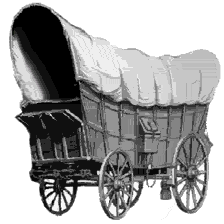
Fortunately, this is no longer the era of covered wagons like you see to the left here, so my accommodations -- the newfangled "airplane" -- will get me to San Francisco in at least half the time.
Now, surely none of you really care all that much about my travel plans to my brother's wedding, beyond offerings of congratulations and curiosity over just how big a disaster my best man speech is going to be, but here's why it matters for this space. There will be baseball. West Coast Baseball. The Mets would not exist were it not for the California-bound relocation of the New York Giants and Brooklyn Dodgers half a century ago, and because the actual Mets are, well, terrible right now, I will instead scope out the forbears of my favorite team who are much better than terrible and actually even in contention for what they call "a playoff berth".
We Mets fans may be unfamiliar with that concept these days, but I assure all of you, it actually exists.
And so, because I will be on the left coast, my sister, I, and a few assorted others will be attending this Monday's Giants-Rockies game at AT&T Park, and while this will not be a new experience for me -- I've been there twice -- it just may be my favorite. Two days later, if we can wake ourselves early enough to make the drive from San Luis Obispo, we will be in Dodger Stadium in Los Angeles to, at long last, knock the second oldest park in the National League off of my list. I'm awfully excited about the prospect.
Oh yeah. And my brother's getting married. That's pretty exciting, too. One of my best friends in college, Luisa Badaracco of my venture to Fenway and TD Garden fame, was at her sister's wedding three years ago when Clay Buchholz threw a no-hitter in his second career start for her Boston Red Sox. Will history repeat itself for my brother Sunday as the historically pitching-rich Mets finally get their first no-no? Well, the odds are a little slim, though this isn't the most unlikely thing I've banked on -- in High School I once told a teacher I'd have to miss a club meeting because I had Mets tickets and I liked their chances for a Perfect Game against the hapless Orioles. The Mets probable starter is R.A. Dickey, who already has a one-hitter under his belt in a surprising knuckleballing season that has him stunningly in the top ten of the NL's ERA chase. His foe -- the equally as hapless Houston Astros in the pitcher's haven of Citi Field.
The stars are aligned. You can pretty much take it to the bank.
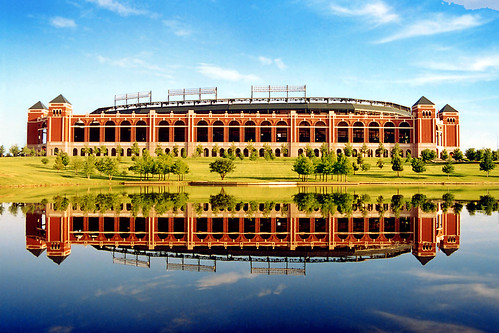
On one last note, it was revealed this week whom the Mets will be visiting in 2011 for interleague play, which is always of great interest to me as I look to strike down stadiums on my quest. Despite much hub-bub that the Amazins would be visiting Minnesota's new Target Field, they will in fact be visiting Rangers Ballpark at Arlington and Comerica Park in Detroit. While I have already been to Comerica Park, the Texas Rangers are new on the list. Who's up for a road trip?
And that's all the news that's fit to print and a whole lot more that isn't in these parts. California beckons tomorrow, again, and the Kalan family will be changed forever. If I can keep my eyes open after crisscrossing the U.S. one last time this month, I'll be sure to tell you all about it next week.
Showing posts with label Luisa Badaracco. Show all posts
Thursday, August 26, 2010
Wednesday, May 12, 2010
Green, White and Parquetry
I know I've been unable to post an actual stadium story in a while, but it's been busy. Hopefully this one can satisfy you for the time being.
Originally written February 15, 2010.
There is an art to making these trips and finding quirks in the schedule. After all, with 122 teams across the four major sports and 113 of them outside my immediate area, making 113 separate trips would seem an exhausting and expensive venture.
Mostly expensive.
Given that, I often have to scan the schedules to find opportunities to maximize my output. That is to say, if there are two teams in one city that play on back-to-back nights, it is a golden opportunity to strike multiple targets off the list in one shot. When such an opportunity presents itself, I’m generally hard-pressed to take advantage.
One such opportunity presented itself in January of 2009. I had been considering coming up to Boston to visit Luisa and my friend Jenn Reiss and with the Devils visiting the Bruins on January 29, 2009 and me having two days off from work the timing seemed right. When I noticed that the Celtics would be home against the Kings the night before, a trip to Beantown seemed all too sensible. I enjoy Boston, but I find the city very strange, mostly because it feels less like a metropolis to me than it does a large town. I know it comes off as condescending, and I don’t mean to seem that way since I really do like walking around the place, but there is one thing about it that always seemed odd to me.
Boston closes at midnight.
Every time I’m there I find this to be completely stunning. Perhaps this is because I’m spoiled as a resident of New York with 24-hour subway access and bars that stay open until four in the morning, but I struggle to see how a major city mostly shuts down before the night gets started. And indeed, Boston doesn’t necessarily shut down at midnight – the T operates until 12:45 and most bars are open until 2 a.m. – but with mass transit stopping so early on a Friday or Saturday there hardly seems any good reason for the drinking masses to stay out much later.
I do enjoy the T because it feels classy and old, while the subway generally feels rundown, but I can’t see staying out to socialize without a ride home.
Of course, I was far more likely to stay out in Boston four months after this visit, when I made my trip to see the Mets visit the Red Sox. That trip featured weather that was pleasant and enjoyable. When I went to see the Celtics the weather that first night provided little incentive to go anywhere but a warm bed.
See, I was lucky enough to plan my trip in the midst of a blizzard that streaked up the eastern seaboard. A week earlier, my friends Bert, Matt and I had made a spur of the moment trip to Washington D.C. to see Barack Obama get sworn in as the 44th President of the United States. That night the drive was smooth and the weather was clear. I suppose it would have been greedy to expect that a second time. This time around the snow had put into question whether or not I would get to Boston in time for the game that night.
As we took an alternate route at the behest of our driver, my bus pulled over to the side of the road on a hill for reasons I still don’t understand. When the driver put his foot on the pedal again, the bus went nowhere, stuck in the snow and rocking back and forth as it failed to gain traction. It was frighteningly similar to the last time I had driven to New England, a trip to see our friend Dan Sonshine at Brown that my friend Justin and I took during our senior year of college. That day a typically three-hour drive took six, and we saw numerous spinouts and accidents along I-95. I’m not sure why I thought it was a good idea to get behind the wheel that day. Aside from the dangerous weather, I was in the midst of a two-week stretch that saw me get four tickets across four different states.
It might have been wise to let someone else drive.
On this trip, as the bus rocked back and forth in the snow, I started worrying that it might tip over. Eventually we heard the driver call into his bosses to tell them someone might have to come tow us out of the drift. They then suggested he put the bus in the lowest gear – why that hadn’t yet occurred to him I have no idea – and sure enough out of the ditch and off to Boston we were.
We eventually pulled into South Station with plenty of time to spare and I hopped on the T to Luisa’s apartment near Hoynes Convention Center. This was my first full-fledged introduction to the weather that day. When I write I don’t generally like to use curse words. In regular conversation it’s entirely different story. I talk like a sailor far more than I should. When I write, however, I only resort to swearing when there simply is no other way to put it.
That day the weather was shitty. Really shitty.
The entire city was covered in slush, it was cold enough to be uncomfortable and warm enough that rain didn’t turn into snow. And boy did it rain. The drops poured down as I made the most uncomfortable three block walk of my life from the T station to Luisa’s apartment in Back Bay. By the time I arrived, I was frozen and soaked to the bone with no desire whatsoever to go back outside. Of course, with three tickets already purchased on Stub Hub for that night’s Celtics game against Sacramento, staying in the apartment would have defeated the purpose of the entire trip.
Throw in the fact that Luisa had to leave the apartment to teach a course on implementing organizational change at MIT and five minutes later we were back outside. Luisa and I walked across the Charles River into Cambridge where I headed to Harvard so I could meet up with Jenn. Jenn and I had known each other since elementary school, and at the time she currently was in her second year at Harvard Law School. While part of me felt bad for dragging her from her studies, she seemed perfectly content to talk English soccer and hound me for gossip on our former classmates from high school. If it meant I had someone to escort me to what was then called TD Banknorth Garden, I was fine with it. A year later the building would shorten its name to simply “TD Garden”, but whether it was either of those two, or the Fleetcenter as it was called when it opened in 1995, most people simply fall back on the habit of calling it “The Garden”.
The building itself looks fairly nondescript from the outside, appearing as though it were just a large concrete box with its only personality coming from its curved arching roof. It sits near the unique Zakim Bridge and atop Boston’s North Station, much like Madison Square Garden in New York rests above Penn Station, meaning before the games crowds of both fans and commuters gather en masse.
Jenn and I grabbed a pint and a burger at a pub not far from the arena before we made our way into the building. As we took the escalator up I was stopped in the ticket line by security because I was carrying my messenger bag.
“No bags allowed,” the man told me.
While the Yankees had been restricting bags from entering Yankee Stadium for years I had never come across it elsewhere and all I could think to tell the security personnel was, “Seriously?”
He gave me a look that said, “You’re a fucking asshole,” and directed me to a much younger, and one might assume, more patient guard, who I was told could give me my options for what to do with my bag. The first one I was given was to go back to my home or hotel and leave my bag there. Considering this was presented to me with the game tipping off in 10 minutes, I could not possibly understand why that was the first option. The guard then told me that I could run to a bar two blocks away from the arena where I would be allowed to check my bag.
This, too, is similar to Yankee Stadium, where bags can be checked across the street at a bowling alley that is frequently full of drunk fans before and after games. I told Jenn to sit tight while I sprinted across the street, and when I checked my bag I expected some cost. That the price was $10 was well beyond my expectations. Clearly the racket was doing well.
“$10?”
“Yeah, I know,” the attendant said. “It’s highway robbery.”
“You know, at Yankee Stadium it’s only $5. Though I guess I’m in the wrong city to bring that up.”
“Don’t look at me,” the attendant said, nonplussed. “I’m a Mets fan.”
It was annoying, but when they’ve got you, they’ve got you. I paid the $10, sprinted back to the arena and in we went. TD Garden is a wonderful facility, but it has a strange aspect to it as you walk through the concourses. The building feels clean and modern, with plenty of Celtics and Bruins memorabilia in cases around the hallways so you know who plays there. But it has the peculiar combination of housing two legendary franchises – the winningest in NBA history and an Original Six NHL team – and yet the building doesn’t have the same legendary feel to it.
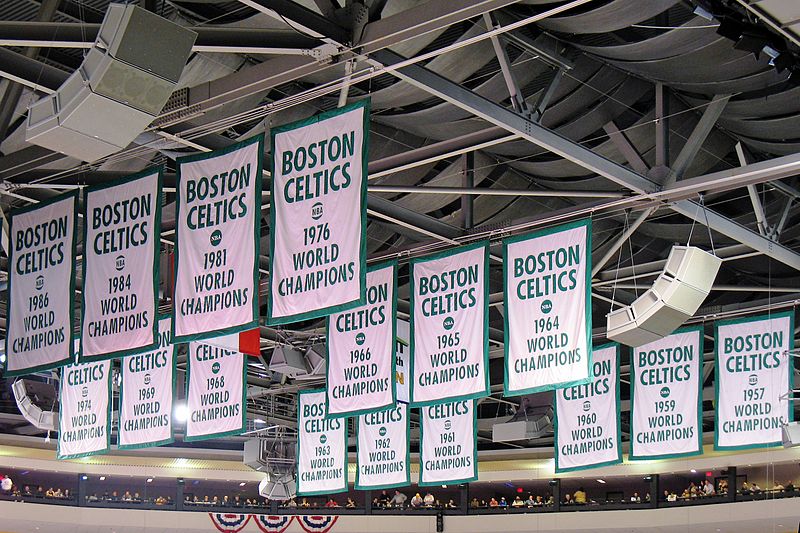
Unlike Fenway Park, to say you felt the ghosts of the arena’s past wouldn’t be right. The Celtics have won more titles, 17, than any other franchise in the NBA and when I went to see them, sure enough, they were the defending champions. But their 2008 title was their first in this building and the first since 1986. This building didn’t have the aura that reminded you this was the team Bill Russell, Bob Cousy and John Havlicek won titles for. You couldn’t smell the cigar smoke of Red Auerbach. But despite being a Knicks fan with no fondness for the Celtics, I will say this: That legendary green and white jersey hasn’t changed, and the classic parquet floor is still there. If you can tune out the building you’re sitting in and see only the game you’re watching, and only those jerseys on that floor, it can give you chills.
If the classic sight of green and white on that floor doesn’t inspire you, a look up towards the top of the building might. I’ve heard that at UCLA’s Pauley Pavilion they use banners as wallpaper, but the blue and gold has nothing on the 17-time NBA Champions. Their banners hang from the arena rafters in three dizzying, mesmerizing rows with the years reeling off in succession, 1957, ’59, ’60, ’61, ’62, ’63, ’64, ’65, ’66, ’68, ’69, ’74, ’76, ’81, ’84, ’86, ‘08. And unlike other arenas, which hang every division title or sellout, this is not the case for the Celtics. Save for retired numbers, every green and white tapestry says, “World Champions.”
They have no use for those other banners here.
Of course the fact that it’s no longer the Boston Garden isn’t all bad. Fans can talk about the ghosts, the legends, the quirks all they want. The building may well have had the character older Boston fans talk about, but it was also reputed to have some of the worst sightlines in professional sports. At TD Garden there isn’t a bad seat in the house. And speaking of the seats, the best decision they may have made in the construction process, and there were many good ones, was that the seats are still the same iconic black and yellow of the Celtics and Bruins’ former home.
The old Garden was cramped, its rink was nine feet shorter than the NHL’s regulation size, and the infrastructure was riddled with problems. The building lacked air conditioning which led to fog developing over the ice during Bruins’ playoff games, and the B’s experienced electrical failures during not just one, but two Stanley Cup Finals appearances in 1988 and 1990. I’m all for history and antiquated charm when it comes to stadiums and arenas. But the lights need to stay on. When they can’t, it’s time to move.
Luisa eventually showed up in the middle of the first quarter and the three of us settled in for a game I wound up enjoying much more than I expected. Not that I was dreading the event, but despite not particularly liking the Celtics, the energy and excitement of the crowd was hard to ignore. Luisa and Jenn managed to find a way, spending most of the opening quarter talking about how attracted they both were to some of my high school friends they had both met.
It’s hard to blame them, though. The Celtics got off to a slow start, eventually falling behind the Kings by ten points. While, I could have cared less who won, this made me look awful after I told Jenn the Celtics should be ashamed of themselves if they don’t win by 20 points. In the early going, it appeared Boston, which had won eight straight games heading into the night, was making a liar out of me. It was only a matter of time before Sacramento, which itself was on a six-game losing streak, let the lead slip away, however.
The Celtics opened the second quarter on a 25-9 run and never looked back. By the fourth quarter the lead would stretch out to 24 points mostly on the shoulders of point guard Eddie House, who sank eight three-pointers, including a 4-for-5 performance from behind the arc in the final 12 minutes. Whenever he touched the ball the crowd would chant his name and he was treated to a standing ovation when he was taken out with just over four minutes to play. By the time the clock wound down, Boston had polished off a 119-100 victory. Although it was one point less than I said they ought to win by, Kevin Garnett, Paul Pierce and company took care of business .
I would have appreciated getting 20 points on the dot, but you can’t have everything. This I realized as soon as I walked back outside into the still driving rain. In fact, that was really the only problem with the day. I would have appreciated getting back to Luisa’s apartment that night and not being soaked to the bone, but sometimes you can’t help those delightful New England winters. At least we were able to get home. The game had ended early enough.
Boston wasn’t yet shut down for the night.
Originally written February 15, 2010.
There is an art to making these trips and finding quirks in the schedule. After all, with 122 teams across the four major sports and 113 of them outside my immediate area, making 113 separate trips would seem an exhausting and expensive venture.
Mostly expensive.
Given that, I often have to scan the schedules to find opportunities to maximize my output. That is to say, if there are two teams in one city that play on back-to-back nights, it is a golden opportunity to strike multiple targets off the list in one shot. When such an opportunity presents itself, I’m generally hard-pressed to take advantage.
One such opportunity presented itself in January of 2009. I had been considering coming up to Boston to visit Luisa and my friend Jenn Reiss and with the Devils visiting the Bruins on January 29, 2009 and me having two days off from work the timing seemed right. When I noticed that the Celtics would be home against the Kings the night before, a trip to Beantown seemed all too sensible. I enjoy Boston, but I find the city very strange, mostly because it feels less like a metropolis to me than it does a large town. I know it comes off as condescending, and I don’t mean to seem that way since I really do like walking around the place, but there is one thing about it that always seemed odd to me.
Boston closes at midnight.
Every time I’m there I find this to be completely stunning. Perhaps this is because I’m spoiled as a resident of New York with 24-hour subway access and bars that stay open until four in the morning, but I struggle to see how a major city mostly shuts down before the night gets started. And indeed, Boston doesn’t necessarily shut down at midnight – the T operates until 12:45 and most bars are open until 2 a.m. – but with mass transit stopping so early on a Friday or Saturday there hardly seems any good reason for the drinking masses to stay out much later.
I do enjoy the T because it feels classy and old, while the subway generally feels rundown, but I can’t see staying out to socialize without a ride home.
See, I was lucky enough to plan my trip in the midst of a blizzard that streaked up the eastern seaboard. A week earlier, my friends Bert, Matt and I had made a spur of the moment trip to Washington D.C. to see Barack Obama get sworn in as the 44th President of the United States. That night the drive was smooth and the weather was clear. I suppose it would have been greedy to expect that a second time. This time around the snow had put into question whether or not I would get to Boston in time for the game that night.
As we took an alternate route at the behest of our driver, my bus pulled over to the side of the road on a hill for reasons I still don’t understand. When the driver put his foot on the pedal again, the bus went nowhere, stuck in the snow and rocking back and forth as it failed to gain traction. It was frighteningly similar to the last time I had driven to New England, a trip to see our friend Dan Sonshine at Brown that my friend Justin and I took during our senior year of college. That day a typically three-hour drive took six, and we saw numerous spinouts and accidents along I-95. I’m not sure why I thought it was a good idea to get behind the wheel that day. Aside from the dangerous weather, I was in the midst of a two-week stretch that saw me get four tickets across four different states.
It might have been wise to let someone else drive.
On this trip, as the bus rocked back and forth in the snow, I started worrying that it might tip over. Eventually we heard the driver call into his bosses to tell them someone might have to come tow us out of the drift. They then suggested he put the bus in the lowest gear – why that hadn’t yet occurred to him I have no idea – and sure enough out of the ditch and off to Boston we were.
We eventually pulled into South Station with plenty of time to spare and I hopped on the T to Luisa’s apartment near Hoynes Convention Center. This was my first full-fledged introduction to the weather that day. When I write I don’t generally like to use curse words. In regular conversation it’s entirely different story. I talk like a sailor far more than I should. When I write, however, I only resort to swearing when there simply is no other way to put it.
That day the weather was shitty. Really shitty.
The entire city was covered in slush, it was cold enough to be uncomfortable and warm enough that rain didn’t turn into snow. And boy did it rain. The drops poured down as I made the most uncomfortable three block walk of my life from the T station to Luisa’s apartment in Back Bay. By the time I arrived, I was frozen and soaked to the bone with no desire whatsoever to go back outside. Of course, with three tickets already purchased on Stub Hub for that night’s Celtics game against Sacramento, staying in the apartment would have defeated the purpose of the entire trip.
Throw in the fact that Luisa had to leave the apartment to teach a course on implementing organizational change at MIT and five minutes later we were back outside. Luisa and I walked across the Charles River into Cambridge where I headed to Harvard so I could meet up with Jenn. Jenn and I had known each other since elementary school, and at the time she currently was in her second year at Harvard Law School. While part of me felt bad for dragging her from her studies, she seemed perfectly content to talk English soccer and hound me for gossip on our former classmates from high school. If it meant I had someone to escort me to what was then called TD Banknorth Garden, I was fine with it. A year later the building would shorten its name to simply “TD Garden”, but whether it was either of those two, or the Fleetcenter as it was called when it opened in 1995, most people simply fall back on the habit of calling it “The Garden”.
The building itself looks fairly nondescript from the outside, appearing as though it were just a large concrete box with its only personality coming from its curved arching roof. It sits near the unique Zakim Bridge and atop Boston’s North Station, much like Madison Square Garden in New York rests above Penn Station, meaning before the games crowds of both fans and commuters gather en masse.
Jenn and I grabbed a pint and a burger at a pub not far from the arena before we made our way into the building. As we took the escalator up I was stopped in the ticket line by security because I was carrying my messenger bag.
“No bags allowed,” the man told me.
While the Yankees had been restricting bags from entering Yankee Stadium for years I had never come across it elsewhere and all I could think to tell the security personnel was, “Seriously?”
He gave me a look that said, “You’re a fucking asshole,” and directed me to a much younger, and one might assume, more patient guard, who I was told could give me my options for what to do with my bag. The first one I was given was to go back to my home or hotel and leave my bag there. Considering this was presented to me with the game tipping off in 10 minutes, I could not possibly understand why that was the first option. The guard then told me that I could run to a bar two blocks away from the arena where I would be allowed to check my bag.
This, too, is similar to Yankee Stadium, where bags can be checked across the street at a bowling alley that is frequently full of drunk fans before and after games. I told Jenn to sit tight while I sprinted across the street, and when I checked my bag I expected some cost. That the price was $10 was well beyond my expectations. Clearly the racket was doing well.
“$10?”
“Yeah, I know,” the attendant said. “It’s highway robbery.”
“You know, at Yankee Stadium it’s only $5. Though I guess I’m in the wrong city to bring that up.”
“Don’t look at me,” the attendant said, nonplussed. “I’m a Mets fan.”
It was annoying, but when they’ve got you, they’ve got you. I paid the $10, sprinted back to the arena and in we went. TD Garden is a wonderful facility, but it has a strange aspect to it as you walk through the concourses. The building feels clean and modern, with plenty of Celtics and Bruins memorabilia in cases around the hallways so you know who plays there. But it has the peculiar combination of housing two legendary franchises – the winningest in NBA history and an Original Six NHL team – and yet the building doesn’t have the same legendary feel to it.
Unlike Fenway Park, to say you felt the ghosts of the arena’s past wouldn’t be right. The Celtics have won more titles, 17, than any other franchise in the NBA and when I went to see them, sure enough, they were the defending champions. But their 2008 title was their first in this building and the first since 1986. This building didn’t have the aura that reminded you this was the team Bill Russell, Bob Cousy and John Havlicek won titles for. You couldn’t smell the cigar smoke of Red Auerbach. But despite being a Knicks fan with no fondness for the Celtics, I will say this: That legendary green and white jersey hasn’t changed, and the classic parquet floor is still there. If you can tune out the building you’re sitting in and see only the game you’re watching, and only those jerseys on that floor, it can give you chills.
If the classic sight of green and white on that floor doesn’t inspire you, a look up towards the top of the building might. I’ve heard that at UCLA’s Pauley Pavilion they use banners as wallpaper, but the blue and gold has nothing on the 17-time NBA Champions. Their banners hang from the arena rafters in three dizzying, mesmerizing rows with the years reeling off in succession, 1957, ’59, ’60, ’61, ’62, ’63, ’64, ’65, ’66, ’68, ’69, ’74, ’76, ’81, ’84, ’86, ‘08. And unlike other arenas, which hang every division title or sellout, this is not the case for the Celtics. Save for retired numbers, every green and white tapestry says, “World Champions.”
They have no use for those other banners here.
Of course the fact that it’s no longer the Boston Garden isn’t all bad. Fans can talk about the ghosts, the legends, the quirks all they want. The building may well have had the character older Boston fans talk about, but it was also reputed to have some of the worst sightlines in professional sports. At TD Garden there isn’t a bad seat in the house. And speaking of the seats, the best decision they may have made in the construction process, and there were many good ones, was that the seats are still the same iconic black and yellow of the Celtics and Bruins’ former home.
The old Garden was cramped, its rink was nine feet shorter than the NHL’s regulation size, and the infrastructure was riddled with problems. The building lacked air conditioning which led to fog developing over the ice during Bruins’ playoff games, and the B’s experienced electrical failures during not just one, but two Stanley Cup Finals appearances in 1988 and 1990. I’m all for history and antiquated charm when it comes to stadiums and arenas. But the lights need to stay on. When they can’t, it’s time to move.
Luisa eventually showed up in the middle of the first quarter and the three of us settled in for a game I wound up enjoying much more than I expected. Not that I was dreading the event, but despite not particularly liking the Celtics, the energy and excitement of the crowd was hard to ignore. Luisa and Jenn managed to find a way, spending most of the opening quarter talking about how attracted they both were to some of my high school friends they had both met.
It’s hard to blame them, though. The Celtics got off to a slow start, eventually falling behind the Kings by ten points. While, I could have cared less who won, this made me look awful after I told Jenn the Celtics should be ashamed of themselves if they don’t win by 20 points. In the early going, it appeared Boston, which had won eight straight games heading into the night, was making a liar out of me. It was only a matter of time before Sacramento, which itself was on a six-game losing streak, let the lead slip away, however.
The Celtics opened the second quarter on a 25-9 run and never looked back. By the fourth quarter the lead would stretch out to 24 points mostly on the shoulders of point guard Eddie House, who sank eight three-pointers, including a 4-for-5 performance from behind the arc in the final 12 minutes. Whenever he touched the ball the crowd would chant his name and he was treated to a standing ovation when he was taken out with just over four minutes to play. By the time the clock wound down, Boston had polished off a 119-100 victory. Although it was one point less than I said they ought to win by, Kevin Garnett, Paul Pierce and company took care of business .
I would have appreciated getting 20 points on the dot, but you can’t have everything. This I realized as soon as I walked back outside into the still driving rain. In fact, that was really the only problem with the day. I would have appreciated getting back to Luisa’s apartment that night and not being soaked to the bone, but sometimes you can’t help those delightful New England winters. At least we were able to get home. The game had ended early enough.
Boston wasn’t yet shut down for the night.
Tuesday, January 26, 2010
Goodbye College, Hello Cleveland
Originally written January 14, 2010
The last few days of college are a bizarre time, particularly for those of us who are without a job or any real idea of where they’re going in life. I had no job lined up and prospects were pretty scarce. I applied to 100 or so over the final few weeks as I wrote my last papers and began packing up. Most of the calls had come from news clipping organizations I had little interest in working for that would have required me to be in the office by 4:30 a.m. on some days. Beyond that the ways to find a job writing in sports in New York without having ever actually interned for a major newspaper seemed few and far between.
I believe it was my stepmother, Audrey, who asked me what I wanted to do for a living the day I graduated. The latter of my two commencements ended at Welsh-Ryan Arena in Evanston and as we went through the obligatory picture taking session by Ryan Field, Northwestern’s football stadium, she posed the question.
“I want to watch baseball,” I said. “For money.”
It was always good for a laugh, and yet I wasn’t particularly sure where I’d go. I had tried my best to balance mailing out resumes, packing my things, and squeezing in all the necessary goodbyes and drunken memories that the final two weeks after finals provide you with. Those goodbyes are tricky. You’re not sure which of the people you’ve spent the last four years with you’re going to still be in contact with and who you need to say goodbye to for good.
And there are some.
But you can’t afford to be too schmaltzy or else your life will never get where it’s going. You just have to take it in stride. And it ain’t easy. But you manage.
I tried not to let it on as I packed my room and scrambled to sell furniture that I wouldn’t be taking back east, but jobless me was a nervous wreck and what laid ahead was a mystery. Fortunately, I had one carrot to distract me from the uncertainty before my mother and I caravanned two cars full of four years back to New Jersey.
For me, I generally would drive from my childhood home in Millburn to Evanston in one shot if I were by myself – all twelve hours of it. My mother couldn’t stand to sit in the car that long in one day and whenever I made the trip with her, we would break it in two, often staying at the same Hampton Inn in Milan, Ohio that had a rather pungent textile factory across the highway from it. That wasn’t always bad, as we would usually eat at the same restaurant, a BBQ grill joint called the Roadhouse, which was the type of place that served you your rack of baby back ribs with a side of 5 oz. grilled sirloin.
But for the trip home my mother had suggested that we instead stay in a nice hotel in Cleveland and treat ourselves. The actual hotel itself that we stayed in was of little interest or import to me, but I did notice one thing that was.
The Indians were in town.
That sealed the deal. When I originally asked my mother if the Indians were in town she told me she had already checked and that they were not playing the Mets. Of course, given that they play in two different leagues, the chances that the Mets would be there that week were scant anyway, but Cleveland was playing Philadelphia. At the very least I could root against the rival Phils. I decided to be the generous one and buy the tickets – after all, my parents had just paid for four years at a private college, I could give my mom a break – and I found two seats in row GG not far behind home plate for the Wednesday evening tilt on June 20, 2007.
And the seats came out to a mere $50 each. I love being impressed by ticket prices that aren’t in New York.
Of course, before the game came there was still the nasty business of graduating, writing my final papers, doing my drinking, saying my goodbyes, packing for home and selling my furniture. The furniture would be the most immediately impactful as I slept on my own bed one night before selling it, then slept on the bed my roommate had left before selling that, and then spent the last night sleeping on our disgusting couch.
The abruptness of the transition is confusing if for no other reason than that you’re not always sure how sentimental to get. Luisa had come over to give me company while I packed my final things and when she left nonchalantly said, “Well, it was fun going to college with you.” It seems simple, but sometimes you aren’t sure how serious to take these things, particularly since in the case of Luisa, we have kept close contact since graduating and college no longer appears to be the basis of our friendship so much as one chapter of it.
This is the case with a number of my close friends, but not so much with others. Knowing who will and won’t stay a part of your life is probably the most uncertain and difficult aspect of transitioning to the real world. Perhaps that's one of the reasons I'm doing this: To have an excuse to go around the country and keep in touch with all of them.
Still, at the time I was far more preoccupied with packing and getting on the road quickly on the 20th. The game itself was the night that we were leaving Evanston, which meant we’d have to make a quick exit to ensure we made it to Cleveland in time for the 7 o’clock start. This would be delayed by, as so often happens between children and their mothers at moments of heightened stress, a fight. In this case it revolved around a parking ticket my mother had gotten while we were loading up the cars that morning and my juvenile insistence that she simply ignore it so we could hit the road.
With the city backlog, my logic went, they’d never know the difference.
This, of course, did not sit well with my mother who made a point to go to the town municipal center and pay the ticket. Considering town hall was next to my apartment building, this wasn’t too big of a diversion.
After getting on the road, cooler heads began to prevail and we left one car behind the other on Lake Shore Drive, where I got my last looks at the city I had called home for four years. As I teetered between lead-footed and sentimental we eventually found our way onto I-80 and, with 90 minutes or so to spare, pulled into the Hilton Garden Inn in Cleveland.
My mother and I checked in and headed to the stadium just a few blocks away. Jacobs Field, or the Jake as it is colloquially known, is often considered one of the best parks in the Majors. This doesn’t come from any sort of trendsetting architecture. The modern trend of faux-retro parks still pulls its impetus from Camden Yards, which beat the Jake to opening day by a few years.
But indeed the intimacy and sight lines are among the best in baseball. To me, however, the most striking architectural feature is outside the stadium. The building’s structure features visible steel beams all around its exterior that give the appearance of an exoskeleton holding the stands up. What was most fascinating to me, however, is that the skeleton and its older style stadium lights are painted a bright white, making them stand out and giving the building an individualized and unique appearance that straddles the line between antiquated and futuristic.
The inside has a few features that might make it seem noteworthy, but nothing overwhelms anything else – with, perhaps, the notable exception of the 149-foot long video screen in left field. At the time it became my favorite park in the Majors. I can’t begin to imagine how much more pleasant it is to watch a game there than it was to do so in the Indians’ former home, the monstrous Cleveland Municipal Stadium, which housed 74,438 fans as opposed to the relatively cozy 43,515-seat capacity of the Jake.
I decided, as I often do, to take a stroll around the park and view it from different angles and see what it has to offer. As I continued my walk I happened upon Heritage Park, a circular museum dedicated to the Indians’ hall of famers and major moments that resides behind the batters eye in center field. Apparently it had just opened that year, but regardless, I hadn’t seen a hall of fame section that was quite so aesthetically pleasing in its subtle appearance and seamlessly weaved into the style of the ballpark. As I’ve visited more parks that have added their own hall of fame sections, I’ve enjoyed seeing the different orientations, but this one teaches you about the club’s history while still maintaining its presence as part of a stadium.
And speaking of being part of a stadium, the outfield concourse at Jacobs Field features a beer garden. Yes, these are common now, but this was the first time I had spotted it, or perhaps as a 21-year-old this was the first time I took note. I don’t much like drinking at ball games. If you have too much the whole experience moves too quickly and you lose track of what’s happening on the field. In the case of baseball, I understand this is preferable for some people but I’m far more concerned with seeing the tension that develops between the pitcher and the batter, and having five too many beers in me makes that infinitely more difficult to keep track of. Regardless, I suppose having the open air beer garden is necessary considering Jacobs Field was paid for by a 15-year sin tax on cigarettes and alcohol.
I will say this, though. The fans at the beer garden certainly looked like they were having fun. In the end that, I suppose, is the key to the experience.
And speaking of beer, as I walked back to my seat I passed by a stand that was selling Leinenkugel’s Sunset Wheat on tap. Sunset Wheat, as any of my close friends could tell you, is my favorite beer on the planet. It’s like candy. The big problem with this lies in the fact that Leinenkugel’s, based in Chippewa Falls, Wisconsin, hadn’t spread much out east. In fact, I had never seen it east of Chicago in my lifetime, to the point that I had made sure to buy a six pack of it before driving back to New Jersey much like I had always made sure to bring a healthy supply of Yeungling back to Evanston.
I don’t really buy beer at baseball games, both because it distracts me and because, usually, it’s outrageously expensive. I don’t need to spend $9.75 on a Miller Lite. But with the prospects of never seeing Sunset Wheat when I returned to the east coast staring me in the face, I bit the bullet – it was only seven dollars – and bought myself a beer to take back to my seat.
Ironically, I would see a six pack of it at the Kings Supermarket in Short Hills, New Jersey a week later. Leinie’s, evidently, had chosen to expand just in time.
The park was more than 50% full that night, but I was still surprised with the turnout after being accustomed to always seeing a full house on TV. In fact, Cleveland sold out the first 455 games at the Jake, a Major League record at the time, which is commemorated with “455” being among the retired numbers that hang against the brick walls in the right field portion of the upper deck.
Granted it was a week night, but the night I was there, the official attendance was a mere 53.7% of capacity at 24,278. For me, however, the average crowd didn’t take away from the game, which, for its first 5 ½ innings was a rather taut affair. Cleveland and Philadelphia had been tied, 2-2, leading up to the sixth inning, when the Phillies took a 4-2 lead courtesy of a two-run homer by Rod Barajas. The Indians responded in the bottom half of the inning by scoring eight runs and having eight consecutive batters reach base to put the game away. C.C. Sabathia pitched six innings to earn the win, becoming the first Indian to get 10 wins in seven consecutive seasons since Addie Joss turned the trick for Cleveland a century earlier from 1902-1909.
As a rule I will almost never leave a game early, particularly if I’m in a new stadium. My diligence paid off in the top of the ninth inning when Shane Victorino came to bat for Philadelphia with two outs. Victorino had two strikes on him when he fouled off a high pitch that banged off the façade of the second deck and dropped down directly in front of my mother and I.
I never will understand why we scrape so violently and irrationally for a dinged up piece of cowhide, but there I was diving to the ground with my sole competition a glasses bedecked woman who appeared to be in her mid-30s. The woman may have been closer to the ball.
But I don’t care. I got it. It was mine. After two decades of watching baseball games and dozens of close calls, at long last, I had caught a foul ball.
The man sitting to my right asked if he could look at it, and perhaps I was too used to trusting everyone in the Midwest as I handed it over to him. Fortunately, he, too, was a trusting non-east coaster. He glanced at the black scuff mark left by Victorino’s bat, handed it back to me and, with a smile, said, “Congratulations.”
On the way out of the park my mother anxiously told me to stop staring at the ball as we walked back to our hotel for fear someone would steal it. Once we returned, I began telling the world, which seemed far less excited about it than I was, before finally getting some rest for the next day’s drive home.
24 hours later, I pulled into our driveway behind my mother, walked inside, and that was it.
College was over.
I remember the morning after my bar mitzvah dealing with the depression that comes after the passing of a major life event. I was older and more capable of handling it now, but this was far more daunting. I now had to find a way to move on. I had to find something to do.
My first post-college job interview was with an HR person at Time Inc, who was testing my worthiness to be employed at SI.com. I admit that I was unprepared. At the very least I should have gone to the website that morning to familiarize myself with it. Of course, that problem didn’t really prepare me for the woman’s first question:
“If an unexpected occurrence were to arise in the office, what contingency would you have prepared for that paradigm?”
I stumbled my way through some nonsense response that showed how unprepared I was and probably cost me the job immediately – I was ushered out of the office shortly afterwards – but what I wanted to say to her was, “You know people don’t talk like that in the real world, right?”
After killing time with my friend Matt for a few hours, I headed to Chelsea Market to interview at MLB.com for the position of a night shift web producer. The atmosphere was far more relaxed and much less formal, and the first thing I had to do was take a written test on baseball trivia. At the very least, even if I blew another interview, at least I’d have some fun.
Afterwards, I went home to continue my post college malaise as I tried to find direction and, most importantly, a source of income, uncertain of what the immediate future would bring.
Two nights later I got an e-mail from the night production manager at MLB.com. I would be watching baseball for money.
The last few days of college are a bizarre time, particularly for those of us who are without a job or any real idea of where they’re going in life. I had no job lined up and prospects were pretty scarce. I applied to 100 or so over the final few weeks as I wrote my last papers and began packing up. Most of the calls had come from news clipping organizations I had little interest in working for that would have required me to be in the office by 4:30 a.m. on some days. Beyond that the ways to find a job writing in sports in New York without having ever actually interned for a major newspaper seemed few and far between.
I believe it was my stepmother, Audrey, who asked me what I wanted to do for a living the day I graduated. The latter of my two commencements ended at Welsh-Ryan Arena in Evanston and as we went through the obligatory picture taking session by Ryan Field, Northwestern’s football stadium, she posed the question.
“I want to watch baseball,” I said. “For money.”
And there are some.
But you can’t afford to be too schmaltzy or else your life will never get where it’s going. You just have to take it in stride. And it ain’t easy. But you manage.
I tried not to let it on as I packed my room and scrambled to sell furniture that I wouldn’t be taking back east, but jobless me was a nervous wreck and what laid ahead was a mystery. Fortunately, I had one carrot to distract me from the uncertainty before my mother and I caravanned two cars full of four years back to New Jersey.
For me, I generally would drive from my childhood home in Millburn to Evanston in one shot if I were by myself – all twelve hours of it. My mother couldn’t stand to sit in the car that long in one day and whenever I made the trip with her, we would break it in two, often staying at the same Hampton Inn in Milan, Ohio that had a rather pungent textile factory across the highway from it. That wasn’t always bad, as we would usually eat at the same restaurant, a BBQ grill joint called the Roadhouse, which was the type of place that served you your rack of baby back ribs with a side of 5 oz. grilled sirloin.
But for the trip home my mother had suggested that we instead stay in a nice hotel in Cleveland and treat ourselves. The actual hotel itself that we stayed in was of little interest or import to me, but I did notice one thing that was.
The Indians were in town.
That sealed the deal. When I originally asked my mother if the Indians were in town she told me she had already checked and that they were not playing the Mets. Of course, given that they play in two different leagues, the chances that the Mets would be there that week were scant anyway, but Cleveland was playing Philadelphia. At the very least I could root against the rival Phils. I decided to be the generous one and buy the tickets – after all, my parents had just paid for four years at a private college, I could give my mom a break – and I found two seats in row GG not far behind home plate for the Wednesday evening tilt on June 20, 2007.
And the seats came out to a mere $50 each. I love being impressed by ticket prices that aren’t in New York.
Of course, before the game came there was still the nasty business of graduating, writing my final papers, doing my drinking, saying my goodbyes, packing for home and selling my furniture. The furniture would be the most immediately impactful as I slept on my own bed one night before selling it, then slept on the bed my roommate had left before selling that, and then spent the last night sleeping on our disgusting couch.
The abruptness of the transition is confusing if for no other reason than that you’re not always sure how sentimental to get. Luisa had come over to give me company while I packed my final things and when she left nonchalantly said, “Well, it was fun going to college with you.” It seems simple, but sometimes you aren’t sure how serious to take these things, particularly since in the case of Luisa, we have kept close contact since graduating and college no longer appears to be the basis of our friendship so much as one chapter of it.
This is the case with a number of my close friends, but not so much with others. Knowing who will and won’t stay a part of your life is probably the most uncertain and difficult aspect of transitioning to the real world. Perhaps that's one of the reasons I'm doing this: To have an excuse to go around the country and keep in touch with all of them.
Still, at the time I was far more preoccupied with packing and getting on the road quickly on the 20th. The game itself was the night that we were leaving Evanston, which meant we’d have to make a quick exit to ensure we made it to Cleveland in time for the 7 o’clock start. This would be delayed by, as so often happens between children and their mothers at moments of heightened stress, a fight. In this case it revolved around a parking ticket my mother had gotten while we were loading up the cars that morning and my juvenile insistence that she simply ignore it so we could hit the road.
With the city backlog, my logic went, they’d never know the difference.
This, of course, did not sit well with my mother who made a point to go to the town municipal center and pay the ticket. Considering town hall was next to my apartment building, this wasn’t too big of a diversion.
After getting on the road, cooler heads began to prevail and we left one car behind the other on Lake Shore Drive, where I got my last looks at the city I had called home for four years. As I teetered between lead-footed and sentimental we eventually found our way onto I-80 and, with 90 minutes or so to spare, pulled into the Hilton Garden Inn in Cleveland.
My mother and I checked in and headed to the stadium just a few blocks away. Jacobs Field, or the Jake as it is colloquially known, is often considered one of the best parks in the Majors. This doesn’t come from any sort of trendsetting architecture. The modern trend of faux-retro parks still pulls its impetus from Camden Yards, which beat the Jake to opening day by a few years.
But indeed the intimacy and sight lines are among the best in baseball. To me, however, the most striking architectural feature is outside the stadium. The building’s structure features visible steel beams all around its exterior that give the appearance of an exoskeleton holding the stands up. What was most fascinating to me, however, is that the skeleton and its older style stadium lights are painted a bright white, making them stand out and giving the building an individualized and unique appearance that straddles the line between antiquated and futuristic.
The inside has a few features that might make it seem noteworthy, but nothing overwhelms anything else – with, perhaps, the notable exception of the 149-foot long video screen in left field. At the time it became my favorite park in the Majors. I can’t begin to imagine how much more pleasant it is to watch a game there than it was to do so in the Indians’ former home, the monstrous Cleveland Municipal Stadium, which housed 74,438 fans as opposed to the relatively cozy 43,515-seat capacity of the Jake.
I decided, as I often do, to take a stroll around the park and view it from different angles and see what it has to offer. As I continued my walk I happened upon Heritage Park, a circular museum dedicated to the Indians’ hall of famers and major moments that resides behind the batters eye in center field. Apparently it had just opened that year, but regardless, I hadn’t seen a hall of fame section that was quite so aesthetically pleasing in its subtle appearance and seamlessly weaved into the style of the ballpark. As I’ve visited more parks that have added their own hall of fame sections, I’ve enjoyed seeing the different orientations, but this one teaches you about the club’s history while still maintaining its presence as part of a stadium.
And speaking of being part of a stadium, the outfield concourse at Jacobs Field features a beer garden. Yes, these are common now, but this was the first time I had spotted it, or perhaps as a 21-year-old this was the first time I took note. I don’t much like drinking at ball games. If you have too much the whole experience moves too quickly and you lose track of what’s happening on the field. In the case of baseball, I understand this is preferable for some people but I’m far more concerned with seeing the tension that develops between the pitcher and the batter, and having five too many beers in me makes that infinitely more difficult to keep track of. Regardless, I suppose having the open air beer garden is necessary considering Jacobs Field was paid for by a 15-year sin tax on cigarettes and alcohol.
I will say this, though. The fans at the beer garden certainly looked like they were having fun. In the end that, I suppose, is the key to the experience.
And speaking of beer, as I walked back to my seat I passed by a stand that was selling Leinenkugel’s Sunset Wheat on tap. Sunset Wheat, as any of my close friends could tell you, is my favorite beer on the planet. It’s like candy. The big problem with this lies in the fact that Leinenkugel’s, based in Chippewa Falls, Wisconsin, hadn’t spread much out east. In fact, I had never seen it east of Chicago in my lifetime, to the point that I had made sure to buy a six pack of it before driving back to New Jersey much like I had always made sure to bring a healthy supply of Yeungling back to Evanston.
I don’t really buy beer at baseball games, both because it distracts me and because, usually, it’s outrageously expensive. I don’t need to spend $9.75 on a Miller Lite. But with the prospects of never seeing Sunset Wheat when I returned to the east coast staring me in the face, I bit the bullet – it was only seven dollars – and bought myself a beer to take back to my seat.
Ironically, I would see a six pack of it at the Kings Supermarket in Short Hills, New Jersey a week later. Leinie’s, evidently, had chosen to expand just in time.
The park was more than 50% full that night, but I was still surprised with the turnout after being accustomed to always seeing a full house on TV. In fact, Cleveland sold out the first 455 games at the Jake, a Major League record at the time, which is commemorated with “455” being among the retired numbers that hang against the brick walls in the right field portion of the upper deck.
Granted it was a week night, but the night I was there, the official attendance was a mere 53.7% of capacity at 24,278. For me, however, the average crowd didn’t take away from the game, which, for its first 5 ½ innings was a rather taut affair. Cleveland and Philadelphia had been tied, 2-2, leading up to the sixth inning, when the Phillies took a 4-2 lead courtesy of a two-run homer by Rod Barajas. The Indians responded in the bottom half of the inning by scoring eight runs and having eight consecutive batters reach base to put the game away. C.C. Sabathia pitched six innings to earn the win, becoming the first Indian to get 10 wins in seven consecutive seasons since Addie Joss turned the trick for Cleveland a century earlier from 1902-1909.
As a rule I will almost never leave a game early, particularly if I’m in a new stadium. My diligence paid off in the top of the ninth inning when Shane Victorino came to bat for Philadelphia with two outs. Victorino had two strikes on him when he fouled off a high pitch that banged off the façade of the second deck and dropped down directly in front of my mother and I.
I never will understand why we scrape so violently and irrationally for a dinged up piece of cowhide, but there I was diving to the ground with my sole competition a glasses bedecked woman who appeared to be in her mid-30s. The woman may have been closer to the ball.
But I don’t care. I got it. It was mine. After two decades of watching baseball games and dozens of close calls, at long last, I had caught a foul ball.
The man sitting to my right asked if he could look at it, and perhaps I was too used to trusting everyone in the Midwest as I handed it over to him. Fortunately, he, too, was a trusting non-east coaster. He glanced at the black scuff mark left by Victorino’s bat, handed it back to me and, with a smile, said, “Congratulations.”
On the way out of the park my mother anxiously told me to stop staring at the ball as we walked back to our hotel for fear someone would steal it. Once we returned, I began telling the world, which seemed far less excited about it than I was, before finally getting some rest for the next day’s drive home.
24 hours later, I pulled into our driveway behind my mother, walked inside, and that was it.
College was over.
I remember the morning after my bar mitzvah dealing with the depression that comes after the passing of a major life event. I was older and more capable of handling it now, but this was far more daunting. I now had to find a way to move on. I had to find something to do.
My first post-college job interview was with an HR person at Time Inc, who was testing my worthiness to be employed at SI.com. I admit that I was unprepared. At the very least I should have gone to the website that morning to familiarize myself with it. Of course, that problem didn’t really prepare me for the woman’s first question:
“If an unexpected occurrence were to arise in the office, what contingency would you have prepared for that paradigm?”
I stumbled my way through some nonsense response that showed how unprepared I was and probably cost me the job immediately – I was ushered out of the office shortly afterwards – but what I wanted to say to her was, “You know people don’t talk like that in the real world, right?”
After killing time with my friend Matt for a few hours, I headed to Chelsea Market to interview at MLB.com for the position of a night shift web producer. The atmosphere was far more relaxed and much less formal, and the first thing I had to do was take a written test on baseball trivia. At the very least, even if I blew another interview, at least I’d have some fun.
Afterwards, I went home to continue my post college malaise as I tried to find direction and, most importantly, a source of income, uncertain of what the immediate future would bring.
Two nights later I got an e-mail from the night production manager at MLB.com. I would be watching baseball for money.
Friday, January 15, 2010
The Mecca of American League Baseball
Originally written June 15, 2009
It bothered me for quite some time that the Cubs were out of town on my first major college visiting trip. When we first had decided to take a jaunt to the Midwest, seeing a game at Wrigley Field, the legendary home of old National League baseball with its ancient grandstands and ivy-covered outfield walls was my biggest priority.
Those priorities had to be reordered after glancing at the schedule, but fortunately, a year later I would not be in a similar spot when my mother and I made a college tour in Boston. Yes, the point of the trip was, ostensibly, to look at universities like Tufts or Harvard – the latter of which I never seriously considered applying to – but for me the entire purpose of the drive to Beantown was to get out to Yawkey Way and make my first visit ever to Fenway Park.
My mother and I checked the schedule after planning our trip and found the Sawx would be hosting the highly mediocre Tampa Bay Devil Rays that week. In a building so rife with history and so low on capacity the seats were appropriately overpriced, but there are only so many opportunities an out-of-towner has to see a hallowed part of baseball history that is mostly unaltered from the day it opened. My mother bought tickets for the two of us as well as her high school boyfriend Richard, who now lived in Massachusetts, and two of his children. For the two of them it was a reunion. For me it was a religious pilgrimage.
We arrived well in advance of our guests and, as I always do when given the opportunity, I stuck along the baseline in the outfield during batting practice in hopes of snagging a baseball. That we, as rational, thinking, complicated psychological creatures go so gaga and go to such desperate lengths to grab a piece of cow hide that is easily purchased at a sporting goods store is always something of a mystery to me, but as I have spent countless hours attempting fruitlessly to snag one, I am in no place to criticize.
On this particular day I came as close to finally bringing a ball home as I ever had before when former light-hitting Mets utility infielder Jason Tyner stepped into the cage for some BP. While I remember Tyner because I enjoyed his scrappy play and quick start when he came up with the Mets, I’m fairly certain that the only people who remember that Jason Tyner ever played Major League Baseball are me, Tyner and my friend Adam Litterman, who could never grasp why his beloved Twins batted Tyner at DH when he had no discernible power stroke whatsoever.
As I waited eagerly and at attention down the leftfield line, Tyner hit a hard ground ball into foul territory and right towards where I had plotted myself against the wall. Sensing my moment for defensive greatness had come I leaned over the wall and put my hat on the ground in hopes of scooping it up as it rolled in. Instead, the ball zipped into my hat, rimmed out and rolled to the unattended nether regions of left field.
While this wasn’t as psychologically damaging as when a middle aged woman pushed me to the ground so she could snag a foul ball I was chasing after at a New Jersey Cardinals game when I was ten years old, I was nonetheless disappointed.
One could possibly assume this was hubris after I had just defended my wearing a Mets hat at Fenway Park to a curmudgeonly usher who grumbled at me upon seeing my headwear.
“May I help you?” I asked, wondering what my offense was.
“A Mets hat?”
“It’s not a Yankees hat.”
“It’s not much better.”
“I was one in 1986. Don’t blame me. Blame Buckner.”
This was the point at which I walked away believing I had cleverly one-upped the Fenway employee. It wasn’t until repeated viewings of Game 6 of the 1986 World Series had shown me I was being a bit presumptuous. While Bill Buckner undeniably bore most of the brunt of Boston’s anguish and outrage after the Red Sox collapsed in Game 6, any astute and knowledgeable student of the game would know that clearly relievers Bob Stanley and Calvin Schiraldi are truly to blame for the Sox squandering their would-be first title since 1918.
While Boston would finally shake the Curse of the Bambino two years later, in absolutely stunning fashion, no less, I became aware that day, April 26, 2002, that my mother was unfamiliar with the Red Sox plight. One of the nice features of Fenway is all of its pennants are posted on the center of the main grandstand behind home plate. As I explained to my mother which ones indicated mere American League titles and which represented World Series Championships, she pieced the math together and realized that Boston hadn’t celebrated a World Champion in baseball in, at that point, 84 years.
I proceeded to explain to her in detail the Curse of the Great Bambino with special mentions to Babe Ruth, Harry Frazee, Bill Buckner, Mookie Wilson and No No, Nanette. This was a profound surprise to my mother who had no clue of any Beantown misery. Of course, by the next time I visited Fenway Park, in May of 2009, Boston’s fortune’s had changed dramatically. The Red Sox had won two championships in the previous five years and were consistently one of the best teams in baseball.
It’s a good thing I made that second trip as I remember a stunningly small amount about the game and the stadium from my first visit. I can probably chalk most of this up to spending most of the night attempting to flirt with my mother’s high school boyfriend’s daughter who had attended the game with us. This was, clearly, an unsuccessful and, given the ties between our parents, an extremely awkward venture, but as an awkward 16-year-old I knew naught for propriety or smooth talk with the ladies. In fact, in the near decade since that game I’m fairly certain that's still the case.
Any time I managed to actually win one over – and it happens once in a while – is a tremendous stroke of luck.
My second visit to Fenway Park very nearly failed to get off the ground, as I had been planning to attend the Mets’ first trip to Boston in three years with my good friend Luisa. Luisa was the first good friend I met in college, as we were grouped together on an outdoor wilderness trip before orientation Freshman year. Ups and downs persist as they do in all relationships, but she, a Bostonian and I, a New Yorker, have relied on our east coast elitism to forge a strong bond with one another.
When I first took note of the Mets’ 2009 schedule I sent Luisa an e-mail with the following words:
“Mets. Sox. May 22-24. Fenway Park. We are fucking going. Period.”
Perhaps my language was a bit brash, but Squeeze, as she was sometimes called, never shied away from profanity and so with months to go before the first pitch, the plan was on. After weeks of scouring auctions on eBay, I finally happened upon two standing room tickets for the series opener on Friday, May 22nd. Unfortunately I was unable to get more than the one day off from work, so my whirlwind trip to Beantown would last a total of 17 hours.
I could generally live with that, but I was unaware that the fun was just beginning. For starters, my bus driver arrived 45 minutes late and announced that he was originally expected to drive a bus to Washington, D.C., but our driver had somehow disappeared.
Into thin air.
I had made the bus reservation fairly early to budget for such a mishap, but one can never anticipate a truck carrying gasoline that explodes in the middle of I-95 and completely shuts down traffic in both directions as a result. That seems like a difficult contingency to prepare for. And so, my bus remained motionless for more than an hour in southern Connecticut as I fretted about my best laid plans running dramatically astray and considered that my hopes of arriving early for batting practice would be reduced to praying I would actually make it for the first pitch. Fortunately, I wasn't the only person on the bus in this position. The man across the aisle from me heard me tell someone I was concerned about making it to the park on time and he turned to me and informed me that no matter what, we were making that game.
I was intrigued to see what plan he had ready for that, but once we passed the completely burned out 18-wheeler traffic picked up. In the end a bus originally scheduled to arrive at 2:15 p.m. finally pulled into Gate 21 at Boston’s South Station around 5:45. I sprinted to the nearest T station, headed to Luisa’s apartment in Back Bay, dropped off my bags and off we were. Luisa was sporting a Sox jersey with her last name on it, which her mother had been presented with by the team at an event once. Luisa asked me if it was lame of her to wear her own name on her jersey, and I told her not to be too concerned by it as I turned my back to lead her out the door and reveal “KALAN” embroidered across my back.
She was elated to not be the only one.
Fenway is, as a co-worker of mine put it, Disneyland for adults. The stadium is so ancient and yet rich with quirks, character and history that placing it all into context in your mind is merely impossible. More than rich with history however, is how rich with fun the building is. Rather than take your tickets at the gate, tickets are required just to get on Yawkey Way behind the stadium, enclosing the street so it can become a large drunken cookout as Red Sox Nation starts a veritable celebration that something greater than any of them is about to happen – a Red Sox game at Fenway Park, the historic mecca of the American League.
Like so many newer stadiums, the outside walls are a rich, red brick face, but these bricks were not thrown in to recreate some architecturally fashionable retro kitsch. These are the bricks that held brand new Fenway Park when it opened its doors in 1912. These are the bricks that housed Carlton Fisk’s waved homer off the foul pole in 1975, Bucky Dent’s back-breaking homer in 1978 and the spark for the Sox’ great rally in the 2004 ALCS. This was home to Johnny Pesky, Dom DiMaggio, Carl Yazstremski, Luis Tiant and perhaps the greatest pure hitter of all time, the Splendid Splinter, Ted Williams.
There is immeasurable history in those walls, and unlike Yankee Stadium, which has seen more than its fair share of history and triumph, Fenway – save for a few alterations – appears the same today as it did then. When you stand within those walls, you feel it. Seeing in person the building you’ve seen on TV a number of times, but never quite grasped until you set foot there is a wild experience. The gigantic John Hancock sign, the far-back stretching bleachers, the short right field wall, the construction beams in the grand stand, Pesky’s Pole and, of course, the Green Monster all pop at you as you walk into the field level and make you feel like you’re somewhere special.
If you’re lucky, like Luisa, you get to experience this every time you go to a baseball game. Much as I adored Shea Stadium and enjoy Citi Field, it is laughable to believe they are comparable to coming here. And given that I rarely have the opportunity to find myself there, and that I had standing room tickets, I was determined to move my way down and get as close a look at the field as I could.
Luisa had clearly never been taught by her father the ancient art of “moving down”. She was not practiced at the old tradition of usurping more valuable seats that you would never in your right mind actually pay for. This was an education for her. Upon walking in, we had already missed batting practice, but the ushers were few and far between, and so we walked about freely needing only to find a pair of seats no one would show up for. Our first stab was in the tenth row behind the on-deck circle, but those seats, we soon found, were spoken for, as were the pair five rows in front that we tried next.
Luisa was anxious we might get in trouble, but I told her to give me one last shot, and so it was that we plopped down some 20 rows behind the first base on deck circle as the game was beginning. The seats had not yet filled in around us and late arriving fans were still coming in through the first three innings. Eventually, the entire section filled to capacity – with the exception of the two seats we had taken.
With the only drawback being a particularly obnoxious Mets fan who sat behind us and yelled brazenly throughout the first several innings – and perhaps Boston’s tradition of singing Neil Diamond’s “Sweet Caroline” every game – we had spectacular seats to enjoy, and, at least for me, a spectacular game. Mets ace Johan Santana was on the hill and delivered a dominant performance as the Mets pulled off a 5-3 win in hostile Fenway. It wasn’t as hostile as normal of course, hundreds of Mets fans made the trip, all of them giving me a vote of confidence when I passed them on the streets of Back Bay afterwards. While the park was divided, we all understood, clearly, that our divisions did not run as deep as our caps and jerseys might have implied.
After all, we all hated the Yankees.
After the game, Luisa and I walked around Fenway, caught some drinks and ate a dessert that was far too large for the two of us, and toured her neighborhood where she gleefully pointed out the palatial manse of the Patriots’ Tom Brady. I will never stop being surprised by how early Boston shuts down, but it didnt' matter as a long day had worn me out and I had an early bus to catch the next morning so I could make it to the office in time. The trip was rushed and hectic to be sure, but few are the opportunities to see a place like Fenway. For all things considered, sightlines, amenities, etc, it is not the best stadium in baseball. Of the places I have been to, I will still defer to Jacobs Field for that designation.
But watching a game at Fenway is an experience unlike any other. I spent less than 24 hours in Boston for the purpose of a baseball game, which, to some, surely, is insanity. But after two games in Fenway Park, I have come to the conclusion that while few places warrant that type of frenzied dedication, if I had to select just one, this would be it.
It bothered me for quite some time that the Cubs were out of town on my first major college visiting trip. When we first had decided to take a jaunt to the Midwest, seeing a game at Wrigley Field, the legendary home of old National League baseball with its ancient grandstands and ivy-covered outfield walls was my biggest priority.
Those priorities had to be reordered after glancing at the schedule, but fortunately, a year later I would not be in a similar spot when my mother and I made a college tour in Boston. Yes, the point of the trip was, ostensibly, to look at universities like Tufts or Harvard – the latter of which I never seriously considered applying to – but for me the entire purpose of the drive to Beantown was to get out to Yawkey Way and make my first visit ever to Fenway Park.
My mother and I checked the schedule after planning our trip and found the Sawx would be hosting the highly mediocre Tampa Bay Devil Rays that week. In a building so rife with history and so low on capacity the seats were appropriately overpriced, but there are only so many opportunities an out-of-towner has to see a hallowed part of baseball history that is mostly unaltered from the day it opened. My mother bought tickets for the two of us as well as her high school boyfriend Richard, who now lived in Massachusetts, and two of his children. For the two of them it was a reunion. For me it was a religious pilgrimage.
We arrived well in advance of our guests and, as I always do when given the opportunity, I stuck along the baseline in the outfield during batting practice in hopes of snagging a baseball. That we, as rational, thinking, complicated psychological creatures go so gaga and go to such desperate lengths to grab a piece of cow hide that is easily purchased at a sporting goods store is always something of a mystery to me, but as I have spent countless hours attempting fruitlessly to snag one, I am in no place to criticize.
On this particular day I came as close to finally bringing a ball home as I ever had before when former light-hitting Mets utility infielder Jason Tyner stepped into the cage for some BP. While I remember Tyner because I enjoyed his scrappy play and quick start when he came up with the Mets, I’m fairly certain that the only people who remember that Jason Tyner ever played Major League Baseball are me, Tyner and my friend Adam Litterman, who could never grasp why his beloved Twins batted Tyner at DH when he had no discernible power stroke whatsoever.
As I waited eagerly and at attention down the leftfield line, Tyner hit a hard ground ball into foul territory and right towards where I had plotted myself against the wall. Sensing my moment for defensive greatness had come I leaned over the wall and put my hat on the ground in hopes of scooping it up as it rolled in. Instead, the ball zipped into my hat, rimmed out and rolled to the unattended nether regions of left field.
While this wasn’t as psychologically damaging as when a middle aged woman pushed me to the ground so she could snag a foul ball I was chasing after at a New Jersey Cardinals game when I was ten years old, I was nonetheless disappointed.
One could possibly assume this was hubris after I had just defended my wearing a Mets hat at Fenway Park to a curmudgeonly usher who grumbled at me upon seeing my headwear.
“May I help you?” I asked, wondering what my offense was.
“A Mets hat?”
“It’s not a Yankees hat.”
“It’s not much better.”
“I was one in 1986. Don’t blame me. Blame Buckner.”
This was the point at which I walked away believing I had cleverly one-upped the Fenway employee. It wasn’t until repeated viewings of Game 6 of the 1986 World Series had shown me I was being a bit presumptuous. While Bill Buckner undeniably bore most of the brunt of Boston’s anguish and outrage after the Red Sox collapsed in Game 6, any astute and knowledgeable student of the game would know that clearly relievers Bob Stanley and Calvin Schiraldi are truly to blame for the Sox squandering their would-be first title since 1918.
While Boston would finally shake the Curse of the Bambino two years later, in absolutely stunning fashion, no less, I became aware that day, April 26, 2002, that my mother was unfamiliar with the Red Sox plight. One of the nice features of Fenway is all of its pennants are posted on the center of the main grandstand behind home plate. As I explained to my mother which ones indicated mere American League titles and which represented World Series Championships, she pieced the math together and realized that Boston hadn’t celebrated a World Champion in baseball in, at that point, 84 years.
I proceeded to explain to her in detail the Curse of the Great Bambino with special mentions to Babe Ruth, Harry Frazee, Bill Buckner, Mookie Wilson and No No, Nanette. This was a profound surprise to my mother who had no clue of any Beantown misery. Of course, by the next time I visited Fenway Park, in May of 2009, Boston’s fortune’s had changed dramatically. The Red Sox had won two championships in the previous five years and were consistently one of the best teams in baseball.
It’s a good thing I made that second trip as I remember a stunningly small amount about the game and the stadium from my first visit. I can probably chalk most of this up to spending most of the night attempting to flirt with my mother’s high school boyfriend’s daughter who had attended the game with us. This was, clearly, an unsuccessful and, given the ties between our parents, an extremely awkward venture, but as an awkward 16-year-old I knew naught for propriety or smooth talk with the ladies. In fact, in the near decade since that game I’m fairly certain that's still the case.
Any time I managed to actually win one over – and it happens once in a while – is a tremendous stroke of luck.
My second visit to Fenway Park very nearly failed to get off the ground, as I had been planning to attend the Mets’ first trip to Boston in three years with my good friend Luisa. Luisa was the first good friend I met in college, as we were grouped together on an outdoor wilderness trip before orientation Freshman year. Ups and downs persist as they do in all relationships, but she, a Bostonian and I, a New Yorker, have relied on our east coast elitism to forge a strong bond with one another.
When I first took note of the Mets’ 2009 schedule I sent Luisa an e-mail with the following words:
“Mets. Sox. May 22-24. Fenway Park. We are fucking going. Period.”
Perhaps my language was a bit brash, but Squeeze, as she was sometimes called, never shied away from profanity and so with months to go before the first pitch, the plan was on. After weeks of scouring auctions on eBay, I finally happened upon two standing room tickets for the series opener on Friday, May 22nd. Unfortunately I was unable to get more than the one day off from work, so my whirlwind trip to Beantown would last a total of 17 hours.
I could generally live with that, but I was unaware that the fun was just beginning. For starters, my bus driver arrived 45 minutes late and announced that he was originally expected to drive a bus to Washington, D.C., but our driver had somehow disappeared.
Into thin air.
I had made the bus reservation fairly early to budget for such a mishap, but one can never anticipate a truck carrying gasoline that explodes in the middle of I-95 and completely shuts down traffic in both directions as a result. That seems like a difficult contingency to prepare for. And so, my bus remained motionless for more than an hour in southern Connecticut as I fretted about my best laid plans running dramatically astray and considered that my hopes of arriving early for batting practice would be reduced to praying I would actually make it for the first pitch. Fortunately, I wasn't the only person on the bus in this position. The man across the aisle from me heard me tell someone I was concerned about making it to the park on time and he turned to me and informed me that no matter what, we were making that game.
I was intrigued to see what plan he had ready for that, but once we passed the completely burned out 18-wheeler traffic picked up. In the end a bus originally scheduled to arrive at 2:15 p.m. finally pulled into Gate 21 at Boston’s South Station around 5:45. I sprinted to the nearest T station, headed to Luisa’s apartment in Back Bay, dropped off my bags and off we were. Luisa was sporting a Sox jersey with her last name on it, which her mother had been presented with by the team at an event once. Luisa asked me if it was lame of her to wear her own name on her jersey, and I told her not to be too concerned by it as I turned my back to lead her out the door and reveal “KALAN” embroidered across my back.
She was elated to not be the only one.
Like so many newer stadiums, the outside walls are a rich, red brick face, but these bricks were not thrown in to recreate some architecturally fashionable retro kitsch. These are the bricks that held brand new Fenway Park when it opened its doors in 1912. These are the bricks that housed Carlton Fisk’s waved homer off the foul pole in 1975, Bucky Dent’s back-breaking homer in 1978 and the spark for the Sox’ great rally in the 2004 ALCS. This was home to Johnny Pesky, Dom DiMaggio, Carl Yazstremski, Luis Tiant and perhaps the greatest pure hitter of all time, the Splendid Splinter, Ted Williams.
There is immeasurable history in those walls, and unlike Yankee Stadium, which has seen more than its fair share of history and triumph, Fenway – save for a few alterations – appears the same today as it did then. When you stand within those walls, you feel it. Seeing in person the building you’ve seen on TV a number of times, but never quite grasped until you set foot there is a wild experience. The gigantic John Hancock sign, the far-back stretching bleachers, the short right field wall, the construction beams in the grand stand, Pesky’s Pole and, of course, the Green Monster all pop at you as you walk into the field level and make you feel like you’re somewhere special.
If you’re lucky, like Luisa, you get to experience this every time you go to a baseball game. Much as I adored Shea Stadium and enjoy Citi Field, it is laughable to believe they are comparable to coming here. And given that I rarely have the opportunity to find myself there, and that I had standing room tickets, I was determined to move my way down and get as close a look at the field as I could.
Luisa had clearly never been taught by her father the ancient art of “moving down”. She was not practiced at the old tradition of usurping more valuable seats that you would never in your right mind actually pay for. This was an education for her. Upon walking in, we had already missed batting practice, but the ushers were few and far between, and so we walked about freely needing only to find a pair of seats no one would show up for. Our first stab was in the tenth row behind the on-deck circle, but those seats, we soon found, were spoken for, as were the pair five rows in front that we tried next.
Luisa was anxious we might get in trouble, but I told her to give me one last shot, and so it was that we plopped down some 20 rows behind the first base on deck circle as the game was beginning. The seats had not yet filled in around us and late arriving fans were still coming in through the first three innings. Eventually, the entire section filled to capacity – with the exception of the two seats we had taken.
With the only drawback being a particularly obnoxious Mets fan who sat behind us and yelled brazenly throughout the first several innings – and perhaps Boston’s tradition of singing Neil Diamond’s “Sweet Caroline” every game – we had spectacular seats to enjoy, and, at least for me, a spectacular game. Mets ace Johan Santana was on the hill and delivered a dominant performance as the Mets pulled off a 5-3 win in hostile Fenway. It wasn’t as hostile as normal of course, hundreds of Mets fans made the trip, all of them giving me a vote of confidence when I passed them on the streets of Back Bay afterwards. While the park was divided, we all understood, clearly, that our divisions did not run as deep as our caps and jerseys might have implied.
After all, we all hated the Yankees.
After the game, Luisa and I walked around Fenway, caught some drinks and ate a dessert that was far too large for the two of us, and toured her neighborhood where she gleefully pointed out the palatial manse of the Patriots’ Tom Brady. I will never stop being surprised by how early Boston shuts down, but it didnt' matter as a long day had worn me out and I had an early bus to catch the next morning so I could make it to the office in time. The trip was rushed and hectic to be sure, but few are the opportunities to see a place like Fenway. For all things considered, sightlines, amenities, etc, it is not the best stadium in baseball. Of the places I have been to, I will still defer to Jacobs Field for that designation.
But watching a game at Fenway is an experience unlike any other. I spent less than 24 hours in Boston for the purpose of a baseball game, which, to some, surely, is insanity. But after two games in Fenway Park, I have come to the conclusion that while few places warrant that type of frenzied dedication, if I had to select just one, this would be it.
Labels:
1986 World Series,
Adam Litterman,
Bill Buckner,
Boston,
Boston Red Sox,
Bus Rides,
College Visits,
Curse of the Great Bambino,
Fenway Park,
Jason Tyner,
Luisa Badaracco,
Mom,
New York Mets
Subscribe to:
Posts (Atom)