Showing posts with label Yankee Stadium (I). Show all posts

Monday, April 19, 2010

Replacing A Monument

Originally written March 23, 2010.

It’s a dirty not-so-secret of mine that despite my masochistic dedication to the New York Mets, my parents are both Yankees fans. It helps that their early lives took place when only one Major League Baseball team was in New York, but in the case of my mother, it helps even more when you grow up with Archie and Jughead in the Riverdale section of the Bronx. My father grew up in the Westchester town of White Plains, and while his grandfather was an enormous New York Giants fans – a picture of my father as a toddler in a black and orange uniform is reputed to exist somewhere – by my father’s 7th birthday there were no New York baseball Giants. With nowhere else to go, he held fast to the pinstripes, though it should be noted that for years after I was born he continued wearing his White Plains High School Class of ’69 T-Shirt, which prominently featured a pennant of the Miracle Mets.

I grew up in a different world. While my father occasionally humored me by pulling for the Amazins my mother made no such ambivalence over her loyalty. That is not to say she didn’t appreciate my fandom. She and I went to dozens of Mets games together over the years, but she made no illusions. She pulled for the Bombers. That was that.

Considering her love for the Yankees, something seemed appropriate about the New Yankee Stadium opening on her 55th birthday, but when I attempted to buy us a pair of tickets, the prices were so high even I couldn’t justify it. And then a plan was hatched. Rather than take my mother to Opening Day at the Stadium for her birthday for what would have been at least $500 for nosebleeds, it seemed a far better idea to get better seats for far cheaper to the second game for not just her and I, but the entire family, with a dinner in the Stadium’s steakhouse beforehand.

Because apparently new stadiums have those things.

Unfortunately, the best laid plans of Mets and Yankees, as they often do, ran astray. After tickets were purchased for the Friday night game against Cleveland on April 17, 2009, the game time was shifted to a 1 p.m. start, which threw an awfully large wrench with my sister, brother and sister-in-law to be all working 9-to-5. My brother and his girlfriend would only be able to make it for dinner afterwards, while my sister would be late. All of this put the screws on three extra tickets that had to be dealt with.

With the date fast approaching, my mother’s close friend, Emily and her son Harry, who was one of my close companions for most of my childhood, took two of the tickets and the final one I managed to sell online – at a profit no less.

With the anxiety gone and the day here, I gathered myself on the subway to check out my 15th Major League stadium. My sister Stephanie would be meeting us at the stadium while my mother, Emily and Harry would drive in from New Jersey. I arrived early for my requisite picture taking, and as the subway pulls up near the park, it’s pretty hard to miss. Indeed it dwarfs the rest of the area, fulfilling an intended impression of massiveness. The building sits across the street from the Old Yankee Stadium, which, at the time of Opening Day for the new park was still standing, albeit eerily empty.

The pinstripes’ new home and the various plazas around it bustled, however, with many people playing tourist just like myself. The most noticeable external feature of the building is the limestone wall that surrounds it. While most new stadiums opt for the aged friendly feel of brick on the exterior, Yankee Stadium doesn’t want to be friendly. It wants to intimidate. It wants you to know that you are not walking into a baseball stadium. You are walking into a temple.

And for $1.5 billion, it ought to. That was the price tag for the building, at the time the second most expensive stadium ever built after the renovated Wembley Stadium in London. The $1.5 billion nearly went for naught after a construction worker, who was also a Red Sox fan, boasted he had put a hex on the new building by placing a David Ortiz jersey in the concrete while on the job. As I’ve said, with the exception of the Chicago Cubs, curses are silly, but sports bring out a peculiar anxiety in the masses, and fake or not, the threat of constantly playing on top of buried Red Sox paraphernalia was of deep concern not only to Yankee fans, but the club’s front office.


With the prospect of Hank Steinbrenner’s supremely expensive baby forever being tainted, construction was halted, concrete was torn up, and sure enough a ragged Ortiz jersey was found in the foundation. The jersey itself was donated to charity and while the worker claimed he had also buried a program and scorecard from the 2004 ALCS – he wouldn’t say where – anymore attempts at cursing the building were quickly proven to be fruitless as the Yankees won their 27th World Series in their first year at the park.

Of course, at the time I first showed up that was a ways off. Things hadn’t been hunky dory in the Bronx – the Yankees were coming off their first non-playoff season since 1995 – and it was important to open the pinstripes’ new home with a bang. They didn’t get it the day before. Cleveland beat the Yankees in their first regular season game there, 10-2. Not that this was the worst thing for me. Despite not being a Yankee fan, I still appreciate history, and the team’s home opening loss afforded us the chance to see the first win at the new home.

I took several pictures around the stadium’s external façade. Its limestone was inspired by the original pre-renovation Yankee Stadium and it makes the building seem more fit for the National Mall in Washington than it does for the Bronx. It is, indeed a beautiful and impressive exterior. After rendez-vousing with my mother, Emily and Harry, there were more pictures to take before we finally entered.

Interestingly, the limestone walls are less a wall than an outer shell, which might explain why the plot of land the New Yankee Stadium covers is dramatically larger than the old one. Between the limestone walls and the seating areas is a huge, open, naturally lit area known as “The Great Hall”. While it is decorated with banners and signs echoing the club’s rich history, “great” seems like a bit of a dramatic adjective for a building that hadn’t actually had anything great happen in it yet.

But as the family Mets fan, who am I to argue?

Along the inside it seems as if every square inch of wall space has been set aside for some purpose to symbolize Yankee history, and when you reach the seating area, which continues to reinforce the franchise’s richness and importance, the full impression is complete. If the purpose of Citi Field was to provide you with an adorable, care-free family outing at the ballpark, the New Yankee Stadium’s aim was to impress upon you the grandeur of its tenants. And it pulls it off with flying colors, with the icing on the cake, and personally my favorite aspect, being the wonderful white frieze that crowns the upper deck.

The white fencing was a key characteristic of the original building when it opened in 1923, but when George Steinbrenner renovated the building in the mid-70s, select sections of the frieze were moved to the outfield while the rest of the stadium was bereft. In the decades since, the team acknowledged a mistake was made, and the frieze has since become a symbol incorporated into the franchise that is as ubiquitous as the interlocking NY. The frieze featured prominently in the stadium’s inaugural season logo and mini friezes adorn the top of each player’s locker.

The frieze was a reminder. It may be in a different place, but this was still the Yankees’ home. In fact, great lengths were made to ensure that the New Yankee Stadium was less a change for cash than an update necessitated by the wear on the old building. Of course, that cash did flow. In its opening season, seat prices ranged as high as $2,625 per seat for a regular season game. Unfortunately for the front office, the stadium opened in the midst of a recession and the embarrassment of empty seats behind home plate, as well as the bad press that came with such high prices while a segment of the fan base was seeking work, prompted the team to cut the cost of the most expensive seats in half.

Because $1,250 is clearly more affordable.

We were not sitting in those fancy chairs, nor in any of the other upper class clubs around the building. We sat in the northern reaches of the upper deck, but behind home plate. Perhaps what is most remarkable about the building is that when you sit in your seat it doesn’t feel like you’re in a different building. Certainly it feels newer, cleaner and, given the wider seats, roomier, but it still feels like Yankee Stadium. And considering the team went to pained extremes to ensure that, it makes sense.

The field itself has the exact same dimensions with the lone exception being a backstop that is now 20 feet closer. While the players must have felt as though they were at familiar environs, however, the stadium didn’t play like it. Perhaps it was the slightly different angle of the building or the vaguely different construction of the outfield stands, but as the Yankees would find over the next six months, baseballs flew out to right field at a stunning pace. Through 23 games at the stadium, 87 dingers would be clocked out of the yard. Right field itself was considered a major culprit, with heavy criticism levied by the media and the park being decried as a joke by some. Numerous wind studies were commissioned but as of the first year at the stadium no certain reason had been determined.

Tensions eased when the pace of homers slowed over the course of the season, but Yankee Stadium’s reputation as Coors Field East, would be firmly entrenched, and true to form, the Yankees won their first game at the new park that day by way of the long ball. A solo home run by none other than uber Yankee Derek Jeter in the 8th inning provided the margin of victory, with Mariano Rivera appropriately nailing down the save in the 9th. Jeter’s homer was the fifth by a Yankee that day.

Despite being stunned that the urinals were already dirty, and confused as to why the Yankees were showing H&R Block Provided Tax Tips on the jumbotron two days after taxes were due, the rest of the experience couldn’t be argued with. From the frieze, to the sightlines, to the hand-managed scoreboard along the outfield walls, the stadium feels like a cathedral, a place befitting the most decorated franchise in American sports.

And despite my own opinions of the Steinbrenner family, they got it right.

With our dinner reservations at NYY Steak in the right field corner waiting, we stayed in our seats while most of the fans filed out to the blaring Frank Sinatra. All the traditions remained to a T. We headed to the restaurant where Elliott and Danielle arrived for dinner and while I felt my porterhouse was slightly overcooked, the meal was a pleasant coda to my mother’s birthday. The restaurant itself doesn’t look over the field, but it does have a wall with the signatures of nearly every famous Yankee ever. In addition, my dessert, was a ball of ice cream topped with chocolate, toffee and a flaming shot of Bacardi 151 rum. They tell you the alcohol burns off, but that is a complete lie. It was the drunkest I’d ever gotten from dessert.

I was quite smug paying for the dinner with my New York Mets credit card, but given that I was going to be back the next day, that may not have been the wisest move. My stepmother had decided months earlier to buy tickets for herself, my father, my stepbrother Jake and I for a Saturday afternoon game, and while I wasn’t necessarily going to have the time to explore the stadium nearly as much, given that we were seated with the Bleacher Creatures I was sure to be entertained.

Fans who spend their days beyond the right field wall at Yankee Stadium are notorious for their dedication, rowdiness and enforced sobriety. Beginning in 2000, the Yankees had banned beer sales in the bleachers in an attempt to curb the wild behavior of its denizens, but this was tenuously overturned for the new building. While we would be in the right field bleachers, we were fortunate enough not to be in the almost comically ill-placed seats at the edge of the section that are next to a wall and as a result have the view of left field completely blocked. Those seats, did, however, provide a clear view of the most expensive seats behind home plate which were predictably empty while the cheaper sections were filled to capacity.

The Bleacher Creatures are noted for their first inning roll call. After each pitch they begin chanting one of the fielder’s names until he acknowledges them with a wave, which is met with a cheer, and each game they go through every man on the field. In addition to that heartwarming connection, however, they also live up to their reputation in amusing vulgarity. It became very obvious very quickly that I could be dominating the field were I playing a game of swear word bingo.

The group was emboldened by an early Yankee lead. Mark Teixeira hit a two-run homer in the first inning – to right field of course – and with two-time 19-game winner Chien-Ming Wang on the mound, surely it was a victory in the making. As Indians right fielder Shin-Soo Choo approached the plate with two men on, one fan in the rows in front of us yelled out, “You suck, Choo! You fucking suck!” Ever the classy gentleman, the bleacher creature’s comment was met with a three-run jack by Choo, putting the Indians in front.

Surely, an isolated incident.

Well before the inning was out Cleveland would string together 13 hits and 14 runs, the largest inning ever surrendered by the Yankees in their history. The frame created a number of records for the new building, and the eventual 22-4 loss for New York would be the third most runs ever allowed by the franchise. Remarkably, the first, second and fourth most runs allowed by the Yankees were all reaped by the Indians in a bizarre coincidence.

The early collapse created dissension among the bleacher creatures who were extremely displeased when one frustrated fan started chanting, “Jeter sucks!” There are certain lines you do not cross in Yankeeville. That particular fan tip-toed it ever so precariously. With the entire section’s ire raised, massive booing and grumbling commenced. One thing they did agree on, however, was that with a pitching change needed, right fielder Nick Swisher was the man for the job. Indeed, Swisher, was no pitcher. But as teams will sometimes have position players take in a few innings to spare bullpen arms in blowouts, Swisher had recently gotten his chance.

Five days earlier the Yankees were routed by the defending-AL Champion Tampa Bay Rays, and with arms at a premium, manager Joe Girardi put Swisher on the mound, where he responded with a scoreless inning, including a strike out of Gabe Kapler on a blistering 78-mile-per-hour fastball that made even Swisher laugh. With the Indians in the midst of their second-inning onslaught, cheers of “We want Swisher” rang from the crowd, but the right fielder was unlikely to come out again.

As he said after his 22-pitch outing in Tampa Bay, "I'm walking out of my professional career with a 0.00 ERA.”

With the result not in doubt, I seized the opportunity to check out one of the few areas of the park I missed the day before, the Yankees museum. Evidently I wasn’t the only person with this idea. When I left a line stretched hundreds of feet outside the doors. The museum features a heaping amount of impressive memorabilia from Thurman Munson’s locker, to Babe Ruth’s jersey, to Mickey Mantle’s cap, to several of the Yankees’ World Series championship trophies.

The literal centerpiece of the museum is a wall of autographed baseballs by nearly every man to have worn Yankee pinstripes from the legendary (Joe DiMaggio) to the forgotten (Woodie Held). While there is an impressive amount of items on display, the room itself is small, and I got the sense that they could have done more with it. After all, these are the Yankees, the most historic, successful, renowned franchise in the history of American sports. If the building befits their greatness, why doesn’t the museum, the place that is supposed to put all the accomplishments on display?

Perhaps I’m being picky. It is still worth the trip, particularly given that Monument Park closes well before game time each day. As I walked past the long line outside the museum and back to my seats, the game’s momentum, unsurprisingly, was still firmly behind Cleveland. The Indians had tacked on another run in both the third and fourth innings, but evidently it took until a three-run homer by Mark DeRosa in the fifth inning for fans to finally give up hope. After the 19th marker had crossed home plate, the stands slowly began to empty, as if that 19th run was the final one that had clinched it for the visitors and made a comeback impossible.

Surprisingly, perhaps out of a desire to look around the new building, my father and stepmother stuck it out until the end of the game, which I was fine with. It was a beautiful day and I make it a point not to leave early if I can help it. Good thing, too. Had we left, we would have missed the third go round of the “We Want Swisher” chant in the eighth inning.

As we and whatever fans left exited the stadium – and there weren’t many – there was laughter and disappointment. Sure these blowouts happen and most educated fans know you just have to let them go, but it was clear that after three games and one win in their new building, for many people this didn’t yet feel like home. They wouldn’t suffer the same malaise I did after visits to Citi Field, however. While the Mets collapsed brutally, the Yankees brought home their first title in nine years that November. With another trophy in tow, I’m sure the new residence felt plenty comfy.

And maybe that new trophy would spruce up the museum some.

Thursday, April 1, 2010

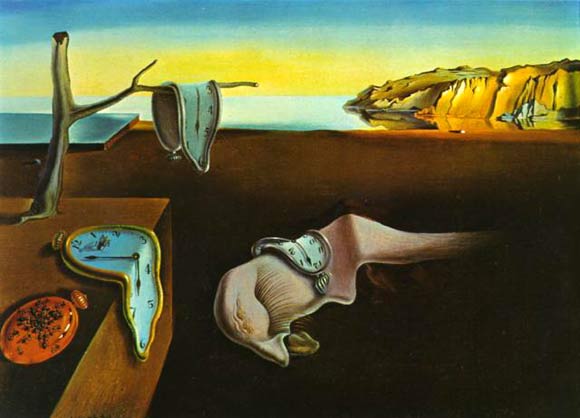
Defecating Publicly On Persistence Of Memory

Yeah, I know. That's a pretty vulgar title, and certainly a number of you are displeased and perhaps confused as to why I'm making that the title to this entry. I rather enjoy the work of Salvador Dali and spent most of college with a poster of "Soft Watch At The Moment of First Explosion" over my desk, but ruining an artistic masterpiece in such a foul manner is pretty much the only way I can accurately describe what the NCAA is apparently planning to do. Reports came out yesterday that Big Ten Commissioner Jim Delaney believes an expansion of the NCAA Tournament to 96 teams is "probable".

The issue will not be determined until the NCAA board gathers to vote on the matter on April 29th, but the thought of altering what, to this point, has been possibly the most intrinsically perfect of American sporting events is wholly unpalatable to just about everyone who watches college basketball, with the exception of coaches and college presidents. And why would they bother expanding the tournament field from 65 to 96 teams? Well, you don't have to be an Ivy Leaguer to figure that one out.

Money. Duh.

This summer the NCAA has the option to opt out and renegotiate its television contract with CBS, and with 30 more games potentially on the docket, that contract becomes a whole lot more valuable. For the coaches perspective, being the skip for a lower-level college team that can now make the dance allows you to burnish your laurels a little more than an NIT berth would, and as for the big program coaches, soft first-round matchups lend the prestige of saying you've made it to the second or third round more often than you used to.

Of course, if these seem like particularly material or vain reasons to expand what is, theoretically, a purely scholastic event about the love of sport, that's because, well, it is. Now I'm not naive. I know this event stopped being about pure competition long ago. Now fortunately, the NCAA is unlikely to pull an Avery Brundage and continue to insist that Division I college sports are all about the love of the game when they clearly aren't. It acknowledges that the bottom line rules here.

And while money is clearly the governing factor, and the likely reason that this will almost certainly happen, it's not ridiculous to express frustration over what will change the greatest weekend in sports. And I'm not the only one who's doing it. The first two rounds of March Madness are a phenomenal show, and every sports fan is so well versed that they can reel off the automatic seed pairings -- 12 vs. 5, 11 vs. 6, 14 vs. 3 -- out of second nature. Two proposals I've read have either the first round expanding to four brackets of 24 teams each or, even worse, the top 32 teams in the country getting a bye to the second round.

The top thirty-two teams!

Hell, we only rank the top 25 during the course of the season. Why should an unranked team with eight losses get a day off? Moreover, if a 16 seed has never beaten a 1 and a 15 has only knocked off a 2 a handful of times, what chance does a 24 seed have of taking out a 1 seed in the opening round? All this does is create dozens of games that will be uncompetitive blowouts or give a day of rest to a team that didn't deserve it. The only upside I could see to this would be if the NCAA decided to share some of the profits with the players of those sacrificial lambs of mid-major schools that are being put out to slaughter, and I'm not the only person to think the idea of paying the athletes has merit. But if you think the NCAA would ever pool money to be distributed among the athletes of its revenue sports, you probably also think expanding this tournament is a good idea in the first place.


What's more, expanding the bracket to 96 teams would cheapen the accomplishment of dancing for smaller schools or throw in bigger programs on off years. I don't need to see this year's UNC freshman-palooza in the tournament, and as an alum of a school that has never made the NCAA Tournament -- and breaks my heart in its failure to reach it year after year -- seeing Northwestern finally break the field because the tourney became more inclusive would feel less like an achievement and more like condescension. I don't want my school's first berth to be gift-wrapped. I want the Wildcats to earn it.

Remarkably enough, Northwestern coach Bill Carmody, who could become a hero in Evanston if the Cats finally get an invite to the ball, is also against expansion.

In the end, fighting the inevitable is pointless, particularly since we will continue watching next year and filling out our brackets like the slaves we are. But perhaps just once, it might be nice if the NCAA listened.

As for the tournament still going on, Saturday's Final Four could be wholly uninteresting if Duke makes its way to a championship, which Vegas has them pegged to do, but I'm still holding out hope that West Virginia can save us from the most reviled school in college basketball winning its first title in nine years.

In other news, another team that went nine years without a championship has officially lost a major part of its history, as the demolition of the original Yankee Stadium is nearly complete. The last parts of the upper deck were torn down yesterday as you can see in pictures here and in the video below.


Color me sentimental, particularly considering I'm a Mets fan, but even I think its odd to see those walls come down. And the one show of the hollowed out old Yankee Stadium next to the new one is just a bizarre site to behold. It still makes me feel strange to know that in just six months, Shea Stadium, Yankee Stadium (I) and Giants Stadium will all be figments of my imagination rather than physical structures (On a side note, the NFL announced yesterday that the new Meadowlands Stadium will be opened by a preseason Giants-Jets game on August 16th. The Jets will be home.).

Yankee Stadium is expected to be replaced by parkland that was lost when the new stadium was built, but the idea of taking your kids to use the swings where Babe Ruth honed his craft is at times awesome and at times, well, strange. At least for me. My kids will never understand it.

On a final note, one that is happier than the rest of this post, I'm pleased to announce that Team No. 32 is officially on the docket, and that lucky team is going to be the Atlanta Braves. I've never been to Atlanta and not gone outside of the airport, so I think a stop at the Coca-Cola factory might be necessary, but the big occasion will of course be seeing the Mets visit their division rivals on May 17th and 18th at Turner Field. I don't have tickets yet, but I'm not anticipating that being a problem and my flight is booked.

My college roommate Sam, an Atlanta native, is likely to be among my companions to the ballpark, and upon hearing that I was a Mets fan, his father thanked me for paying for Tom Glavine's retirement. Sam repeated this mantra throughout college.

I wholly expect to hear it again. And I'm awfully excited about it.

Thursday, February 18, 2010

Why Don't The Knicks Just Trade The City Of New York?

Ah the strong, masculine sport of figure skating, thy name is Johnny Weir.

Don't get me wrong, I can appreciate figure skating, and I understand that it is, in fact, very very difficult to do. I even enjoy watching it from time to time, but what I can't understand is that with hundreds of millions of people watching you perform your triple salchows, this is what you chose to wear?

Really?

I have no sense for fashion -- I wore birkenstocks, cargo shorts and hockey jerseys for most of college -- but I can't possibly imagine anyone would find this attire appropriate for any situation whatsoever. Then again, I suppose I'm not one to judge if you want to look like a woman whose dress has just been ripped open or a worn out fur coat. Everyone makes their own choices. And I do realize that part of Weir's appeal is his flamboyant choice of vestments, but don't we think this is pushing it just a wee bit? Particularly since Men's Figure Skating outfits have been silly, but never quite this silly?

I suppose the only sillier thing is why I'm asking the question. I don't fault Weir for his choices. I just think his attire may take away attention from the actual artistry or technical proficiency of his performance. And after all, isn't that, you know, the point?

I suppose I ought not to get involved, particularly since I've been paying far more attention to skiing, snowboard cross, curling, short track and not surprisingly hockey. I was extremely dismayed last night at around 2 a.m., however, to find that RCN Cable is cutting off the last hockey game of the night in the middle of the third period to show infomercials. Last night in particular, when Slovakia and the Czech Republic was cut off despite playing the first watchable hockey game of the tournament was a ridiculous offense.

It's possible that there's a wider conspiracy here. So far Canada has done a decent job of owning the podium -- the host nation has won six medals including its first two golds on home soil -- but it wouldn't surprise me if the Canadians were trying to sweep hockey under the rug until their boys get to the medal round because they might be worried that people will find out the greatest Canadian isn't really Canadian anymore.


Then again, it could jut be crappy TV scheduling. Either way, I'm still getting to watch more Olympics coverage than I know what to do with. Of course getting to watch up to six channels of coverage from two different countries at a time at the office helps that, but I'm enjoying it despite the overstimulation.

Remarkably, the Games have distracted me from the fact that Pitchers and Catchers report to Mets camp today, which is either a blessing or a curse depending on how you feel. I haven't quite made up my mind yet, but the Mets actually playing baseball this year can't be the worst thing I've come across this week.

And speaking of bad ideas, the Knicks are apparently trying to trade everything but the kitchen sink to Houston for Tracy McGrady. I shouldn't really call it a bad idea. Acquiring McGrady's expiring contract would help clear out the cap even more for the NBA's 2010 Free Agent Extravaganza, and enable the 'Bockers to offer two max contracts and possibly turn this sinking Titanic around after a decade of futility. One would hope with that much space, New York can finally sign the pieces to become a winner again. Unfortunately, as this authentic video of the negotiations shows, well, the Rockets are asking for quite a bit.


Still, personally, with how bad this team is aside from David Lee and Danilo Gallinari, I can't really have a problem with any move that starts to clear away the rotten scraps. Bring it on. Houston may be extracting everything it can from Knicks GM Donnie Walsh, but I've seen bigger scams.

In other news, I will be putting my aforementioned letter writing project on hold until I have a chance to speak with a lawyer. While I'm excited to see what it turns up, a rudimentary bit of investigating revealed that it might constitute mail fraud. Until I have that straightened out, I will be waiting to get the ball rolling. I'm sure it's too small a case to ever be prosecuted -- there are far bigger frauds out there -- but it only makes sense to proceed cautiously.

Before I close shop today, I thought I would send a sentimental note out there to all my friends who are Yankees fans. I've never been a huge fan of Yankee Stadium (I), and I've often found talk of the ghosts and tradition of it to be a little silly ever since the building was renovated in the 1970s, but as I did spend a number of nights in my teenage years at the House that Ruth Built, it was a bit sad to see these pictures last night, showing that even the most hallowed and beloved of Stadiums eventually meet their end. We probably should have all expected to see Yankee Stadium torn down, but it doesn't make the images any less significant.

Lastly, I would like to extend a hearty thanks to the unsinkable Molly Turner of Kansas City, Missouri, who along with Susie Sharkey, may have single-handedly tripled my reader base -- at least for a day -- by publicizing Monday's story about my trip to see the Kansas City Royals. My hits across the flyover states saw an absolutely staggering increase, and while I don't expect the readers to keep coming without my mentioning their favorite city, if they do, well, I owe Molly and Susie a drink. Possibly two.

Enjoy tonight's Olympic coverage. And if you're not a Mets fan, enjoy the baseball, too.

Monday, January 18, 2010

The Frozen Tundra

Originally written January 2, 2010

The Peters are a tall family.

To a person modest in stature such as myself, this is the most readily apparent fact about them. Kyle stands somewhere in the neighborhood of 6’4”, his father is in a similar range and his brother, whom I didn’t meet during my stay at their home in Elm Grove, Wisconsin, is apparently somewhere in the neighborhood of 6’7”.

Just to make things clear about how much larger they are than you, their television is a 73-inch HD flat screen which took up the entire wall of their den.

Their distinct height advantage is somewhat intimidating. Ironically, Kyle is anything but. He is confident and sure of himself, but also one of the most genuine people I’ve ever met. I first met Kyle during an ill-fated flirtation with Northwestern’s club Ultimate Frisbee team my freshman year of college. I wouldn’t get to know him well until the next year when we took multiple German courses together.

By the time senior year came around, Kyle lived down the block from me on Foster street between Maple and Ridge, and we would occasionally get together to watch football. That said, Kyle and I ran in different social circles, so outside of German classes we didn’t socialize all too often on a regular basis, which left me somewhat surprised at the beginning of senior year, when he called me to let me know that he was going home to Wisconsin to see the Packers-Saints game on September 17, 2006 and would I like his extra ticket.

This was the Packers. This was Lambeau. The Frozen Tundra. The Oldest Football only facility in the NFL. Home of the Ice Bowl. Home of Bart Starr, Paul Hornung, Max McGee, Vincent Lombardi. This was it. This was Lombardi in his fedora stalking the sidelines and Starr diving over Jerry Kramer to land the Packers in Super Bowl II. This was the deep baritone voice of John Facenda as the camera pans up on those high green walls on NFL Films Presents. Lambeau Field, the cathedral of the modern National Football League, and a place legendary for its fans, its tailgating, its atmosphere and, perhaps most notably, its championship be-decked tenants.

“Yes, Kyle. I will go.”

This journey wouldn’t be so far, however. Milwaukee is a mere 90-minute drive from the north side of Chicago, so our trip to Kyle’s home in Elm Grove, Wisconsin would be a breeze. Until, that is, I arrived and realized how much shorter I was than everyone else. Not that the intimidation lasted very long. The Peters’ height was outstripped by their hospitality. Not more than five minutes after I walked through the door I had been made aware of the television, my bed for the night, and the stocked fridge to which I was more than entitled.

To say I was overwhelmed by the homespun-ness of the Badger state in my first real excursion outside Madison or Milwaukee was to put it lightly. My first real sign of this was the Sunday morning talk radio decrying the Packers’ signing that week of Koren Robinson. In fact, one talking head called it “the bottom of the barrel”.

Why?

Robinson was not terribly far removed from several productive seasons with the Seattle Seahawks, but, you see, he was a drug addict. I, personally, am as straight as an arrow. Perhaps too straight. But I tend to fall on the side of drug users deserving understanding and aid rather than ostracism. However, what shocked me was less the ostracism than the actual offense. Robinson had not been addicted to heroin or cocaine. He had been using marijuana.

It’s not my thing, but I never considered it a particularly dramatic concern either. It had always been my experience that pot smoking happened among a large sector of high school and collegiate America, and I never believed it to be a serious problem.

My cohorts in the car to Green Bay seemed to feel differently.

They also considered Robinson’s pot use to be a significant offense and to chalk it up to Midwest naïvete would be insulting to them. They were all intelligent people. But it was clearly a dramatically different cultural line than I was used to, and a surprising one considering Brett Favre’s own struggle with pain killer addiction, an issue I considered little better.

Perhaps the most telling part of the experience however, came along I-43 when Kyle’s mother was pulled over by a highway trooper for breaking the speed limit. If there ever was a sign of how dedicated the state of Wisconsin is to the Green Bay Packers there is none more obvious than when a representative of the law bends their rules for the Green and Gold. The trooper was a female officer in her mid 30s with short blond hair and a soft Wisconsin accent. Upon staring into the car and noticing the preponderance of Packers jerseys she asked the only question she could, and perhaps the most unnecessary.

“Are you going to the game today?”

After informing her that, yes, we were she did not skirt her responsibilities. She wrote the ticket, but rather than explaining all the complexities, she made quick work of it, telling Kyle’s mother when the ticket was due to be paid by before apologizing to us pulling us over and then wishing the Packers the best of luck and sending us on our way. Surely, there were responsibilities for her to attend to, but on Sundays in the Dairy State the Pack reigns supreme.

Green Bay is a remarkable town. At a population just over 100,000 people, it is by far the smallest city to have an NFL franchise. Compared to the likes of New York, Chicago or even St. Louis it is fairly small and sleepy. When the Packers play just about all of downtown is completely barren with the exception of the stadium and the sports bars surrounding it.

What is most wonderful about Green Bay is that it is the last remaining link to the NFL in its purest foundations. I’m not one of those obnoxious antiquated scribes who refuses to believe anything can match the magic of yesteryear. That is a total fallacy. The NFL today is better than it ever has been in my life.

Still, Green Bay harkens back to when the NFL was a rag-tag group of traveling teams based in smaller Midwest cities. The Frankfort Yellow Jackets, Canton Bulldogs, Duluth Eskimos or Pottsville Maroons would never survive in the modern NFL. The fact that the Packers have managed to stick is a testament to a time when the League was a far less rigidly – and far less financially solvent – version of its current self. Smaller teams had a way into the fledgling League but with the increase in travel costs and the onset of the depression most went the way of the dodo.

And yet the Packers live. Green Bay might have joined them were it not for the efforts of Bears owner George Halas, who heavily campaigned for the city to help fund the construction of Lambeau Field, or City Stadium as it was known when it opened in 1957. While Halas was in one of the biggest cities in America, he felt it was important to have the NFL maintain connections to its small town roots, and with other NFL owners threatening to force the Packers to move to Milwaukee if their stadium conditions weren’t improved in the mid-1950s, Lambeau Field saved the only connection the league has left.

You certainly feel this as you pull into the area around the stadium. While we parked in the Stadium lots, people far and wide were offering their lawns as parking space for a mere $10 a car, a situation you almost never see in professional sports now. As I would find throughout the course of the day, a Packers home game feels like a college game with the rowdiness and single-minded dedication of its fan-base and the tightly packed-in nature of its seating configuration. It is intimate while feeling huge and huge while feeling intimate. It is intense, and crazy from early morning tailgating to the final seconds of the fourth quarter.

It is, in short, the most fun atmosphere I have ever experienced at a sporting event. And the home team didn’t even win.

Who knew watching a team named after a meat packing factory could be so fun?

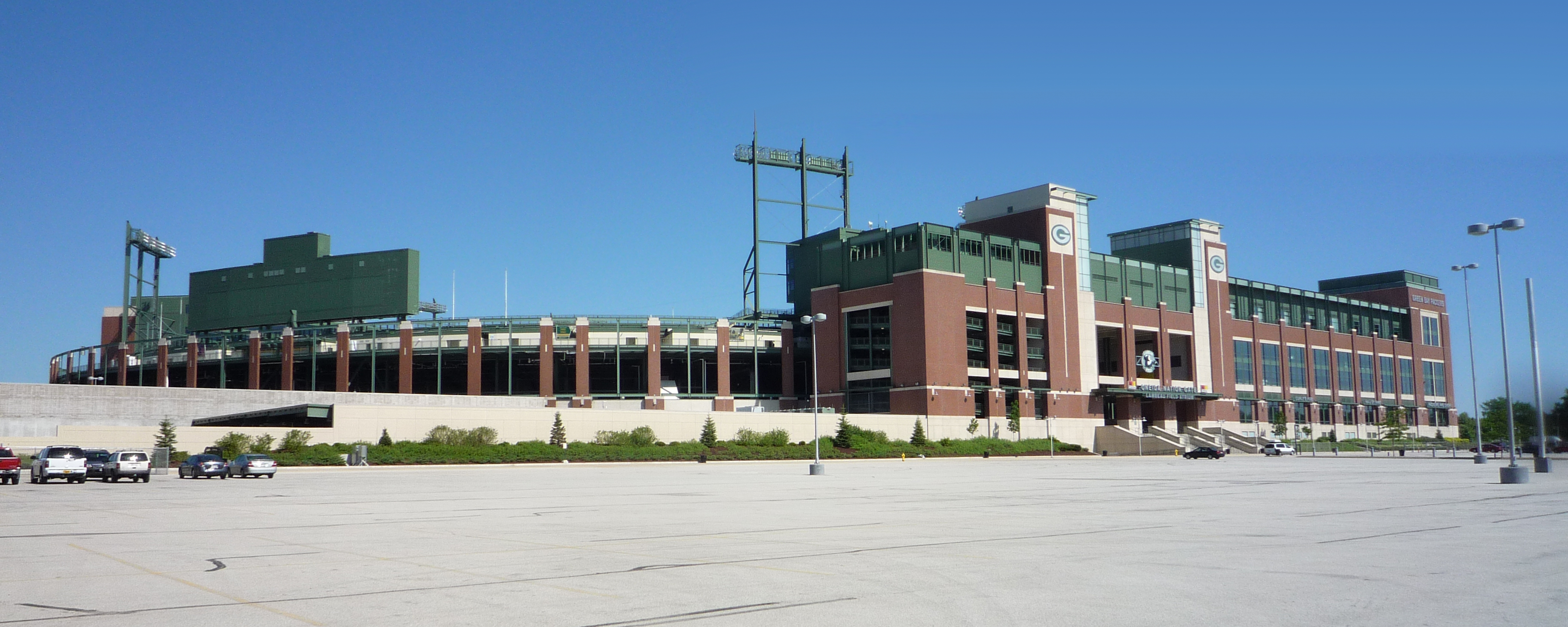
Of course, this was surprising considering I was disappointed when we pulled into our parking spot and I got my first glimpses of the stadium. Unbeknownst to me, Lambeau had undergone an extensive renovation a few years earlier. The affect on the building was actually fairly minor – much of the construction revolved around the addition of luxury boxes and a large atrium outside the walls of the bowl – but that, right there, is what was missing. The new atrium looks nice, but at its expense was the iconic green walls I had always seen on TV.

No matter. This was Wisconsin and I was still going to get my fill of brats, cheese and beer before entering the stadium regardless of what it looked like. And damnit I was going to like it. It was about two beers and several servings of cheddar cheese and crackers in that I noticed Kyle’s friend Casey had a ring on his finger. Casey, you see, was hitched. This really threw me. Casey was my age and happily married, but he certainly didn’t look much older than, well, a youthful college student.

While this was hardly a significant, or perhaps even unusual development to everyone else there, I couldn’t stop thinking about it for most of the day.

But if Casey had a curveball he had thrown me, I had one to throw him. That came about when a man in the parking lot was trumpeting his tuba to the strains of “Roll Out the Barrel”. For the uninitiated, “Roll Out the Barrel” is a drinking song very popular in the upper Midwest. That is, I must assume, the only place it is popular. In fact, while I have heard it a number of times, I have never heard it anywhere but within the borders of the state of Wisconsin.

According to Wikipedia the song, officially called the “Beer Barrel Polka” is actually a Czech song popular during World War II and that it has popped up in various bits of culture ever since, including Marx Brothers movies, Arthur Miller’s “Death of a Salesman” and the regular set lists of Liberace. Of course, I don’t believe any of that for one second. Until I attended a Milwaukee Brewers game in 2001, I had never heard of it before, and after I attended a Wisconsin-Northwestern football game in 2005 I hadn’t heard it since. Perhaps it is actually a Czech song and a huge influx of immigrants from former Soviet Republics to the Midwest following World War II brought their beloved polka with them, popularizing it across Wisconsin, Minnesota and Iowa.

More likely, I think, is that people in Wisconsin just really love beer. Well, they do. That much is irrefutable. After all, their baseball team is called the Brewers and they play the song during the seventh inning stretch of every game.

When the strains of “Roll Out the Barrel” were wafting towards us I said to Casey, “You know that no one outside of Wisconsin knows this song, right?”

“What?”

“I had never heard it before I came here. No one sings it. Ever.”

“Not even at ball games?”

“No, that’s what we have ‘Take Me Out to the Ball Game’ for.”

If Casey had given me something with which to ponder the stability of my reality, I felt sufficiently confident that I had returned the favor.
With kickoff nearing we made our way into Lambeau for the start of the game. The aforementioned addition ran up a $250 million-tab between 2000 and 2003, somewhat jarring when you consider the $960,000 price tag for the entire building in 1956. Still, the atrium is gorgeous, and reminds me very much of the main entrance of Miller Park, while the added luxury suites, restaurants and Packers Hall of Fame no doubt keep Green Bay a financially viable and competitive franchise among the big dogs of the NFL.

Walking in you can feel the history, as if you were at Wrigley or Fenway, and that is because when the Packers made their renovations, they avoided the mistake of the Yankees, who essentially rebuilt the original Yankee Stadium in the 1970s and robbed it of its antiquated mystique. While the Packers may have changed the external appearance of their home, the interior bowl remains relatively unaltered. It is a crowded, packed and thoroughly un-modern grandstand, with tight seating arrangements and poor traffic flow.

And that is what makes it great. Sitting in the stands now one feels as if sitting there during the heyday of Lombardi was no different. Watching Brett Favre and watching Bart Starr must have been markedly similar.
Kyle’s seats were in section 113, a mere 20 rows off the 20 yardline. We would see Favre up close early on, as he hit Greg Jennings for a touchdown in the first quarter. The Packers would jump out to a 13-0 lead. Jennings made the storied Lambeau Leap after scoring.

Of course, the joy would be short-lived. New Orleans overcame three early turnovers by Drew Brees to eventually pull out a 34-27 victory. The last seven of those Packer points came on a touchdown pass to recent Northwestern alum Noah Herron. If memory serves correctly, the three Wildcats among us broke out in a chorus of the Northwestern fight song when Herron broke the plane, but looking back, it’s entirely possible that it was just me.

I spent much of the day glancing at the scoreboard, a time-honored sports tradition these days. With the onset of nationally televised games and fantasy sports, keeping track of the league as a whole has become more important than ever before. And as a result I spend more time than I care to say staring at the out of town scoreboards.

I find few things more fun than the spontaneous, widespread reaction of a crowd watching a dreaded opponent win or lose on the out of town scoreboard. Of course in this particular instance, the entire section would not be cheering with me when I started screaming. This happened when the Giants, who had trailed 24-7, pulled out a remarkable 17-point fourth quarter to force overtime in Philadelphia. If you’ve ever cheered on your own team via the out of town scoreboard in another, entirely unrelated stadium – and I know that is a rather particular set of circumstances – it is a bizarre experience.

When Big Blue tied it, though by what means they had done it I had no idea, I was not silent. Of course, with the Packers trailing by 14 points at the time, much of the section was befuddled by my excitement, causing many confused looks from the crowd around me and one young boy to ask his grandmother why on earth I was so happy.

This theme would continue in the car ride as the Packers postgame announced on the radio that Eli Manning had thrown a 31-yard touchdown pass to Plaxico Burress in overtime to give the Giants the win. As I celebrated in the back of the car, Kyle, his mother, Alec and Casey were all extremely unamused.

For those of you who haven’t been to Lambeau, the one positive you can take from that is you’ve never had to leave it. This is not because it is such a wonderful monument to the gridiron that you want to stay forever – though that is true – but rather, Green Bay, geographically, is pretty far up there and for most fans there is only one way to leave. As a result, traffic stands still.
For a while.

It took more than three hours to make a return trip to Elm Grove that should have been only two.

But even with the traffic, Packers fans always have one trump card that the rest of us don’t. Every Sunday they get to watch a team so deeply connected in the veins of NFL history and the heart of their community. It’s a team that they, themselves in the city of Green Bay own. It is a situation unlike any other in the NFL.

And perhaps best of all, they get to watch them at Lambeau. That, too, is an experience unlike any other.

Tuesday, January 12, 2010

Alright, Let's Lay Down a Few Ground Rules Here

So with some more free time on my hands and that visitors counter going to the extremely exciting number of 20, I figure I should explain some things before I head to bed.

Because I have already made roughly a quarter of my way through this long and difficult journey of mine, there is already a hefty amount of stuff that has been written. I will not put it all up here at once, however. I will spread it out from time to time, maybe once a week or so, to keep it all from coming out at once and to keep you coming back for more. As well, the chapters I have written are not always brief and concise. To those of you who know me, this is, I'm sure, not surprising at all. In fact, some chapters are fairly long -- the one of Shea Stadium because it is the stadium to which I am most attached for example -- and I will not be posting all of them.

The posts will get unwieldy and boring to say nothing of the damage that could be done to your eyes by reading the whole thing start to finish -- as if we don't already spend our entire days sitting in front of a computer screen.

For those particularly long chapters, I may post bits and pieces of them over time as they include multiple stories. Hopefully each of them will be fairly easily digestible. With that in mind, old stories from Shea Stadium and Yankee Stadium (I), two places I attended baseball games at for nearly 20 years, will probably pop up from time to time. Along that same vein, stories from Citi Field and Yankee Stadium (II) will begin to pop up as they happen. I'll leave the messy business of condensing them all into a book for a few decades down the line when I've got more patience for it.


Another thing, there will be multiple posts regarding future trips when they come around in advance of and during them. Some of this will just be informational, some of it will be in hopes that those of you in other cities might notice and choose to join me.

Next point. I know I'm hoping to spread these trips out over an extended period of time, but I'm also not made of money. Let's not be silly. Maximizing efficiency is the key, and generally I will follow my home teams in the process. It won't always line up perfectly, but generally I will try to see more than one team if possible on each trip. A recent weekend, which I did not make a trip for, saw the Devils visit the Minnesota Wild and the Giants visit the Minnesota Vikings on consecutive days. Flukes of the schedule like that are pure gold. I will be on the lookout for them.

Next. Some things that have been done and will be written about are going to be rude, distasteful, and once in a while illegal. Not by me really. I'm too straight an arrow for my own good and I'm pretty sure I never do anything too wrong -- much to my parents disappointment it seems. In the events when something illegal has happened, I will not be naming names. At least not until the statute of limitations has passed.

Lastly, and perhaps most importantly, I am not objective.

Nope. Not one bit. Not even a little. Why did I bother getting into sports in the first place if I didn't have a team I rooted for? And with that in mind you ought to know that much of these trips will involve following the New York Giants, New York Mets, New Jersey Devils, New York Knicks, Northwestern University and, to a lesser extent, the Chicago Blackhawks.

I have my reasons, and I accept no arguments on this.

And if the city of Philadelphia is involved, I am likely to be less than open-minded.

With all that laid out, I think I'm good for now. And if some of you are still confused, well, it's 2:10 a.m. and I want to go to sleep. You'll have to figure it out for yourself.

The first story will be posted tomorrow when I wake up. Get excited.