Showing posts with label Zach Silka. Show all posts

Monday, April 12, 2010

Motown And The Matchup That Never Was

Originally written January 8, 2010.

I remember sitting in my college apartment during Game 7 of the 2006 NLCS. It was a fairly sizable apartment, number 2N at 2060 Ridge Avenue, near the corner of Ridge and Simpson. It had three very large bedrooms at a relatively reasonable distance from campus and a relatively reasonable price considering. There was ample street parking and a lot that was free on weekends right next door, not to mention a nifty little porch in the back alley where I would sit to study when the weather was nice.

Of course in Evanston, that was about four weeks out of the school year.

There was one problem with the living room, however, in that I’m fairly certain it was, well, slanted. It drifted towards one corner, which everyone noted when they came by. That debate, typically, was reserved for more light-hearted and drunken occasions of which, being that it was my senior year of college, there were many. But the night of Game 7, the lighthearted conversation was scarce.

The Mets were playing that night. After rallying to force Game 7, tonight was the night, at long last, I would see my Mets return to the World Series. They had gone six years earlier, when I was 15 years old, but I didn’t nearly appreciate the staggering difficulty of the feat. I spent most of my teenage years watching the Yankees win titles, and assumed, finally, it was the Mets turn to make a run.

That was foolish. After seeing them drop to the dregs of multiple 90-loss seasons in the early part of the decade, 2006 was an exciting blast of fresh air. That was a year when everything – absolutely everything – went right.

And then the NLCS came against St. Louis, and the bats went cold. All of them.

But after forcing Game 7, at home, the Mets got on the board in the first inning and at that moment I was convinced that all would be right. Everything was in order. Little did I know that would be the last run the Mets would score that year. I wouldn’t realize it for a while. In the bottom of the 6th inning, Endy Chavez made the greatest defensive play in Mets franchise history, and possibly the greatest I had ever seen in my life.

With the game tied, the Cardinals Scott Rolen hammered a fly ball to left field that looked like a no-doubt two-run homer, but instead Chavez leaped over the eight-foot high wall and snow-coned the ball in his mitt, bringing the homer back and throwing out Jim Edmonds at first for an inning-ending double play.

As soon as Carlos Delgado caught the ball at first base I collapsed to the couch and simply repeated “Oh my God” to myself over and over again. That was the moment. That was it. At that moment I knew the Mets were going to the World Series. They had to. How could they not after a play like that. It was a forgone conclusion. God had preordained that the blue and orange would be playing in the fall classic, and that would be the seminal moment we told our children about decades later – the moment when Endy Chavez saved the eventual 2006 World Champion New York Mets.

It wasn’t meant to be.

New York loaded the bases in the bottom of the inning, and surely that would be when the floodgates opened, but instead, the Mets were unable to get the go-ahead run across. Yadier Molina hit a two-run homer in the top of the ninth inning, and Carlos Beltran would strike out looking with the bases loaded on a knee-breaking curveball from Adam Wainwright. That was the season. The Cardinals, not the Mets, would faced off with the Detroit Tigers in the 2006 World Series.

I had been text messaging my girlfriend to give her updates, and though she was a Yankee fan, she understood the dire circumstances. When I sent her a text saying “2007 World Series Champions” implying that next year would be the year, she responded with, “OH MY GOD! NO WAY! NO WAY!”

This was followed a few seconds later with, “Oh, I misread… sorry.”

What made this more painful was that Detroit, where Games 1 and 2 of the World Series would be played was but a five and a half hour drive from Chicago. I had already made up my mind that when the Mets got to the World Series in Detroit, I would spend what I had to to make the. But as so often happens, my best laid plans ran astray.

Fortunately for me, I got another chance to see my boys in Motown – albeit with less impressive stakes.

The New York Mets were expected once again to compete for the NL East crown in 2007, but the schedule makers did them no favors. Their interleague slate was a bizarre sampling across all three divisions of the American League, the rhyme or reason behind which I couldn’t quite figure out. But regardless, the Mets visited the Tigers in early June. Not only would this represent a rare chance to see the Amazins in a new park, it happened to be comfortably wedged between my final exams and graduation from Northwestern. With no real plans to occupy my time, the room for a day trip was ample.

So with that in mind, I waited patiently the day tickets went on sale, scooped up four for the Saturday afternoon game and plotted my moves. On June 9, 2007, I would be in Detroit, Michigan at Comerica Park.

Typically when I buy tickets from teams, I’ll have them left at will call rather than sent to my home. This reason is two-fold. Firstly, most teams have individualized ticket stubs that they print out on sight as opposed to generic “Ticket Master” stubs. Since I keep all my stubs, the more interesting the better.

Secondly, and most importantly, if I’m picking up my tickets at the stadium, I can’t lose them in the months before I actually attend the game. That’s a big one.

So with eons before the game it became an after though as I sifted through the final five months of college. The problem this brought about, however, as I sifted through my final classes and graduation arrangements, is that I forgot to find people to take the other three tickets.

Whoops.

Fortunately, Alan Allmen came to the rescue. I originally met Alan when my roommate Sam and I had he and our friend Evan use their senior class priority to net us a better dorm room sophomore year. There was the potential for a snafu, however, and Alan had made it clear he did not want to be stuck rooming with the New Jerseyan.

Yes, it would have been terrible for him.

It would all work out and Alan and I would become friends to the point that I attended his wedding the following summer. By the time my senior year had rolled near its end, Alan and his wife Rachel lived on the south side of Chicago, and Alan, a native of the Detroit suburbs, was more than willing to make the day trip. But what of the other two tickets? Zach Silka, my former compatriot in the Daily Sports office and one-time roommate had since graduated, and moved back home to Toledo. Toledo being within driving distance of Detroit and Zach fancying himself a Tigers fan, he was more than game and brought a friend to take the final ticket.

At times I couldn’t tell if Zach was a baseball fan, trouble-maker or both. This theory was brought to test near the end of my junior year, when I brought my laptop to Intro to Music on Opening Day so I could watch the Mets game online. Zach made sure to grab the seat next to me that day, but this was particularly curious considering Zach was not taking that class.

Beyond that I have two particularly strong memories of living with Zach, the first being that even though he graduated a third of the way through senior year, he left all of his furniture at the apartment so we, and our friend Abe who took his place the rest of the year, could use it. The working idea was that Zach would come back for commencement and leave with all his furniture. No fuss no muss. Of course, Silka curiously had not yet shown up yet by the morning of graduation. When I called him to find out where he was he told me that his family had actually decided not to come. This raised a question however.

“Ok, Zach,” I said. “But what about all of your furniture?”

“Oh…. Um, well, congratulations, Dave! Happy Graduation!”

I wasn’t quite sure what, exactly to do with my new presents: a coffee table, desk, dresser and a mattress, and Zach will swear to this day that he had sold the furniture to Abe and it was no longer his responsibility, but I’m fairly sure that isn’t the case. Fortunately, over the remaining few days I managed to hastily sell all of it on craigslist and pocket a few hundred dollars of walking around money.

The other, and perhaps more relevant memory that comes to mind is from October of senior year when Zach sat on the edge of our couch before screaming and collapsing to the ground after Magglio Ordonez clubbed a three-run walk-off home run off Oakland’s Huston Street in Game 4 of the 2006 ALCS, clinching Detroit’s 10th American League pennant. Zach also likes to claim he was there the last time the Tigers won the World Series in 1984. He was, in fact, not alive yet, but his mother was in attendance and pregnant with him at the time.

With all four tickets spoken for, I got behind the wheel of my 1994 Camry wagon on June 9, 2007 and headed for Alan’s apartment. Alan was one of the more dependable people I knew, and sure enough he was waiting for me on his apartment stoop when I pulled up. In he jumped and off we were for the 330-minute venture to the Motor City.

I had never been to Michigan before and was dutifully impressed with the wide array of fireworks stores at the Michigan-Indiana border along with the periodic billboards boldly proclaiming religious, pro-life or libertarian sentiments. This is not specifically endemic to Michigan. You’ll find these charming bits of local culture in any sparsely populated, rural stretch of highway.

But what you won’t always find is Culver’s. And like nearly every road trip I made across the Midwest, a stop for butterburgers and frozen custard was not optional.

Eventually, we neared Detroit and Alan gave me a brief history of the city and its landmarks, specifically the many buildings that, during the height of the auto boom came to symbolize Detroit’s grandeur and now epitomized its economic struggles. Detroit is not a bad looking city, as many of those from the area had told me. It simply looks like a place where money hasn’t been put into the infrastructure in decades, which, for the most part, is true.

But beyond that, Detroit still has a number of scenic landmarks, and a beautiful riverfront cityscape. The historic Fox Theatre is near the stadium, as are a number of parks and historic churches. Looking back on it, the city of Detroit clearly has its problems, particularly having seen the economic troubles endured by the major automobile companies in late 2008, but it is a hub of culture and character that deserves to be saved and reborn.

The people I came across were generally nice, city and what it has to offer was interesting and the antiquated architecture of some of its buildings gave it an old-timey appeal that I found heart-warming. One of those older buildings which stood at the time and has since been demolished was the original Tiger Stadium nee Navin Field. Amongst the older buildings in the Majors it did not sit far from the Tigers’ new home of Comerica Park, which replaced it in 2000.

Another older building was the one I parked in for $10 a few streets away. It clearly had been built at some time in the 1920s and I found its tight corners fascinating, which is a good thing because they were also treacherous and the fascination forced me to focus on not hitting the walls. In fact, the ramp up to the parking deck was so sharp and narrow that I’m stunned I didn’t.

With the first five-hour plus drive of the day behind us Alan and I walked up to the park to get our tickets. Comerica is a beautiful stadium and while it is similar in its appearance and intimacy inside to most of the current ball parks being built, it has one very notable, and obvious structural difference. If you can’t figure out the Tigers play here you must be extremely visually impaired, because there are statues of tigers everywhere.

EVERYWHERE.

The main entrance to the stadium has two enormous prowling tiger statues arched over the top of the gate, with six more tiger statues in other areas of the park, including the two full color statues that stand atop the centerfield scoreboard. In addition, 33 stone tiger heads surround the outside of the building with baseballs in their mouths. The ubiquity almost seems hokey, but I heartily enjoy it. A team’s home should look like its home, and Comerica Park clearly belongs to the Tigers.

We picked up our tickets at will call, left two there for Zach and headed into the building. Comerica on the inside provides all the standard niceties that you’ll find in newer stadiums. It has outfield picnic areas and varied food options, with the usual wide concourses. The most interesting part is the section beyond the outfield wall in left center that pays tribute to the team’s history.

There are enormous statues of each Tiger who has had his number retired such as Al Kaline or my personal favorite, Hank Greenberg. Greenberg’s statue is my favorite not only because of his Jewish background, but also because all the statutes are designed to give them a super-human quality, and Greenberg’s which features not one but three baseballs coming off his bat, looks particularly powerful. The only Tiger whose number isn’t retired that still gets a statue is Ty Cobb. Of course, that comes with the disclaimer that the Georgia Peach’s number isn’t retired because he has played in an era when players did not yet wear them. The only non-player to have a statue in the building is longtime Tigers announcer Ernie Harwell near the first-base side. Given that man’s dedication to the franchise, and the city of Detroit, he may be the most deserving of all of them.

The field itself is absolutely enormous. Center field stretches out to 420 feet, while left center is 370 from home plate, and that’s after the club shortened the fences following the 2002 season. My only real aesthetic problem with the stadium is that the shortened left field fence is a painfully obvious alteration to the park’s original lay out. The space behind the shortened fences was used to create new bullpens, and as well, the flag pole contained within the area is no longer in the field of play. But the wall itself looks flimsy and temporary – the only scar on an otherwise picture perfect stadium.

That afternoon was picture perfect late spring weather, and Comerica had its Sunday finest on – even if it was actually Saturday. The ivy on the fountain in dead center field gave the park a certain natural quality that is rare, even in newer buildings, and matched perhaps only by the ivy-covered walls of Wrigley Field. Comerica also features two other minor quirks, namely the strip of dirt running from home to the pitchers mound, and the home plate shaped dirt field surrounding the batter’s box.

I dig it.

We were seated near the top of the upper deck and just to the left of the left field foul pole. Despite the nonpreferential viewpoint, the sightlines are still pretty good. There is little on the field of play that I couldn’t see from one of the worst vantage points in the building. As Alan and I stood in our seats, we were joined by Zach and his friend Ryan. I hadn’t seen Zach in nearly six months and it was good to catch up with him, as I told him how the rest of senior year went and he regaled me with the wild stories of Toledo’s bar scene.

The game itself was a fairly unexciting affair because the Mets had Oliver Perez on the mound. The excitement with Perez was that his stuff was so good that any day he stepped on the mound there was a chance of him throwing a no-hitter. He was also absent-minded, lazy and unpredictable, so there was a more likely chance that you’d see him get pasted.

True to form, he served up a three-run shot to Carlos Guillen in the first inning as Detroit jumped ahead 3-1. The Tigers would eventually build an 8-3 lead, and while New York would score four runs in the seventh and eighth innings, you never got much of a feeling that Detroit wasn’t in control.

This didn’t particularly bother me. After all, if you have a great regular season you’re still going to lose roughly 60 times a year. The Mets at the time were 12 games over .500 and in first place and I never would have expected what happened that September when New York took a seven-game lead into the final 17 games before completing one of the great collapses in baseball history. But, this trip was less about the chance to pick up a win than the opportunity to see a new team, a new building, a new city and a new fan base. Of course, when I saw the Tigers fan base it was met by a sizeable Mets contingent. Something I’ve learned in years of traveling to see the Metroplitans is that they travel awfully well.

I’ve run across large crowds in orange and blue in Detroit, St. Louis, Chicago, Milwaukee, Boston, Washington and Philadelphia. That this was an afternoon game made this a particularly strong group, but there was no tension, no discord. Instead, there was a jovial and conciliatory atmosphere as opposing fans cheerfully ribbed one another and laughed afterward. A man at a Mets game once told me a Mets-Red Sox game at Fenway was the most peaceful place he’d ever been because everyone was unified in their hatred of the Yankees.

This was not exactly the same, but I drew some clear parallels. After all, the Mets and Tigers almost never play each other. Why should there be any conflict?

That day, was purely about love of the game.

As I walked down the steps of the upper deck and towards the exit ramps, I was stopped by a group of middle aged fans. One who appeared to be in his mid-40s, was wearing a Mets jersey with a script “New York” on the front that they sported in the 1980s. He told me that while Mike Piazza, who was on the back of mine that day, was good, the only guy better was player on the back of his. It was Lenny Dykstra. I think I would argue that. And I'm damn sure Piazza is better at handling finances.

The eldest one of the group, who had to have been in his 60s put his arm around me and patted me on the back with joking condescension as if to say, “Don’t worry, buddy. It’ll be ok.”

“It’s alright,” I told him. “We’ll see you in October.”

And we all laughed. Because that’s what everyone was thinking.

No one in the building that day had thought the Mets and Tigers wouldn’t meet again in the World Series that year, and as a result, everyone was cheery and pleasant.

Little did we know that neither team would even make the postseason, the Tigers themselves would have a tough second half that left them eight games became the surprising Cleveland Indians. In the end both Mets and Tigers fans would have to watch on TV as their stadiums wound up empty.

Despite the final score that day, I was satisfied with another successful trip as Alan and I got back in the car, carefully pulled out of the narrow parking garage, and hit the highways for the five and a half hour ride back to Evanston.

And there was a stop at Culver’s along the way of course.

The day itself was long from end to end, and I was extremely tired by the time I got back to my apartment, but I somehow managed to go to a bar afterwards. In fact, I think I made a point to do so every night for the next two weeks.

I had to. College was almost over.

Tuesday, February 23, 2010

Memories From Milwaukee

Originally written on May 22, 2009

While I had already decided I wanted to see every Major League Baseball park, my first exposure to stadia outside the New York area came in the spring of 2001. I was 15 at the time, and while the long parade of college visits most American High Schoolers endure was not yet in full swing, my mother had wanted to visit my sister at the University of Wisconsin that April and figured it was as good a time as any to get the show underway. Our first stop came in Evanston, Illinois, where I would be exposed to Northwestern University, an event that would obviously have longterm ramifications. I was hoping to see Wrigley Field for the first time that week, and I did, but the Cubs had hit the road, and while my mother and I did accidentally wind up attending a White Sox-Twins game at the new Comiskey Park, a story for another time, I have a far stronger recollection – and perhaps connection – to a later stop we would make in Wisconsin.

This probably has to do with the fact that the Mets were involved.

When my mother and I had planned out the trip to visit my sister in Madison, I noticed that Milwaukee, not a far drive away, was on the schedule for the Amazins’ current road trip. This more or less set in stone that whenever the Mets are within 200 miles of me on the road, I have to attend. After begging and pleading, we finally bought tickets for myself, my mother, Stephanie and her roommate.

In both Chicago and Milwaukee, this would be the first time I saw parks that came in the modern style. While we were impressed when we saw Comiskey, the excitement would fade after the trip to Miller Park and Milwaukee made it clear the Sox had missed the boat. Granted, given that Miller Park was in its first season and Comiskey in its 10th the fight was not fair. The Brewers had had time to see where the popular architectural fads would go before breaking ground on their new home.

But advantages aside, what a home it is. While Comiskey was the first stadium I saw a game in that hadn’t been built before 1965, Miller Park was the first I had been to that fell under the architectural trends started in Baltimore when the Orioles cut the ribbon on Camden Yards in 1992. As well, as the Brewers’ new home had only been in use for three weeks at the time I got to it, it hadn’t yet lost its new car smell. The floors were all smooth and clean, the concourses were wide with direct views of the field, the plaza outside was bereft of litter – even the parking lot signs were shinier.

For someone who had spent their life walking the cold, characterless, narrow concourses of Shea Stadium and Yankee Stadium, this was an overwhelming wakeup call for what the baseball viewing experience could be. It was clear that a stadium did not simply have to be the vessel for telling the story. It could aesthetically become one of the characters.

Miller Park is a visually striking building from the outside. Its external walls are covered in red brick that give it the flavor and appearance of a traditional, older park, but at the same time, the stadium is fitted with a retractable roof that could never be confused with a structural element of the 1920s. It is a deep green that finds its apex above the stadium’s main gate, behind home plate, and fans out across the top of the park. While the roof when closed does make the experience feel somewhat artificial, the areas above the brick wall and beneath the edge of the roof are large glass sections that allow natural light to pour into the stadium. The entire back wall of the building also opens up to allow sunlight to illuminate the playing surface.

The sightlines are phenomenal and the fans are a dedicated bunch who are well-humored when the Brew Crew is in lean times, and raucous in the winning seasons. The highlight for many at the stadium is, of course, the Sausage race, which takes place midway through the 6th inning, when contestants dressed as a hot dog, german sausage, polish sausage, italian and chorizo sprint around the diamond. The silly, but highly enjoyable spectacle has been copied in numerous other stadiums.

The race also gets a fair amount of televised publicity, and may have received the most attention in 2003 when the Pirates’ Randall Simon knocked down the italian sausages mid-race with his bat as a joke. When it became apparent that he had injured University of Wisconsin student Mandy Block who was racing in the costume, the contrite Simon gracefully accepted a three-day suspension and his $432 fine after being cited for disorderly conduct. He purchased a free sausage sandwich for every fan in section 432 when he returned to Milwaukee as a member of the Cubs weeks later, while Block, and this is not a joke, would be awarded a certificate of bravery from the National Hot Dog & Sausage Council.


Despite the raging popularity of the sausage race, however, my favorite in-game quirk of the Brewers is the tradition of Bernie Brewer dropping down a gigantic slide in the outfield after each Milwaukee home run. Given the jet stream in the park, this happens quite a bit. My love for this tradition comes not out of zest for seeing a cartoony, mustachioed mascot being dropped on a platform to wave around an oversized Brewers flag, but rather because every time I see it, I try to imagine Bernie Brewer sliding into an enormous mug of beer. Not only would this be infinitely more awesome than landing on a raised platform, but it would be keeping a connection alive to the Brewers’ former home of Milwaukee County Stadium, where Bernie did, in fact, dive into a giant mug of beer each time a Brewer went yard.

The platform will have to do.

Most of my first visit was spent staring in awe and watching my mother suffer one anxiety attack after another as she feared for my safety when I made obnoxious comments to native Wisconsinites about the superiority of my defending-National League champion Mets. Coming through for me as they always do, the Mets lost that night. In the years since, I have found the Mets often lose when I see them on the road. They love to make their brash fan base look good, after all. On a positive note, the game was particularly memorable for the fact that defensively challenged Mike Piazza threw out not one, but two would-be base stealers in a single inning. As I remarked at my surprise, a Brewers fan in front of me asked me when the last time Piazza had turned that trick was. I told him I wasn’t sure he ever had.

The four of us all received souvenir fishing hats with a logo for Miller Park’s inaugural season on them as a free promotional item, which is surely buried in a pile somewhere in my childhood home. As I began attending Northwestern University two years later, less than 90 miles south of Milwaukee, this would not be my last stop at Miller Park. In fact, over several visits whenever the Mets were in town, I have become more and more familiar and more and more a fan of its grounds. I have developed fond memories of chatting with other displaced Mets fans and receiving angry scowls from seven-year-old girls when I openly cheered.

On one occasion I had taken a weekend vacation to Milwaukee with my friends Mike Trawicki, Amit Marwah and Blake Kluger for some Mets-Brewers baseball, a round of golf and, of course, Culver's. On the way up we would see some very interesting license plates and be fairly confused by a sign for America's Black Holocaust Museum. I would find that golf is indeed, as Mark Twain put it, a good walk spoiled. In my case, I broke a wedge while frustratingly banging it into the fairway leaving Mike to talk the course into not making me pay for it. The highlight of that trip was probably Mrs. Trawicki’s homemade cinnamon bun frosting, though a venture to try Mike’s long-vaunted Milwaukee Mexican food comes close, but my favorite incident came when I tried my hand at entrepreneurial negotiations at the stadium. As a 15-year-old Cracker Jack vendor walked by I asked him if he was interested in making a deal.

“How much for that big Cracker Jack bag you have around your shoulder?”

“Uh….”

“I’ll give you $20 for it.”

“Um… let me ask my manager.”

The summer before, a co-counselor at Fairview Lake named Cody Umbach had tried the same trick at a minor league New Jersey Cardinals game and come away with a free souvenir simply because they had extras. Fifteen minutes later when the vendor returned, I’d find in the majors, even in Milwaukee, they weren’t quite as generous.

“Uh, yeah, my boss told me they’d fire me if I sold my bag to you.”

“Well, what if you went to the bathroom and somebody ‘stole’ it?”

“I don’t think we can do that after I already asked my boss about it.”

Undeterred, another Cracker Jack vendor came by, who must have been in his early 40s and I posed him the same question.

“Eighty bucks,” he said.

I passed.

The memories weren’t always good ones at the stadium, mostly because the Mets, despite generally being the superior team, usually lost. One such day, Bill Hall clubbed a walkoff home run on Mother’s Day in 2006 with his pink breast cancer awareness bat to send the Mets and Pedro Martinez to a defeat.

The game I will remember most clearly in the stadium, however, was from the day before, when I, my girlfriend at the time, Jess, and my senior year college roommate Zach Silka had driven up to Milwaukee to see a thriller of a game. The Mets would actually prevail after Paul Lo Duca’s solo shot off Derrick Turnbow lifted New York to a 9-8 win just a half-inning after Milwaukee had erased a four-run deficit on back-to-back homers. The game, however, is not memorable to me because of its thrilling, and satisfying conclusion, nor is it memorable because my friends Deek and Feiny, who drove in from Madison to meet me for the game nearly picked a fight with some of the drunker Brewers fans in the crowd.

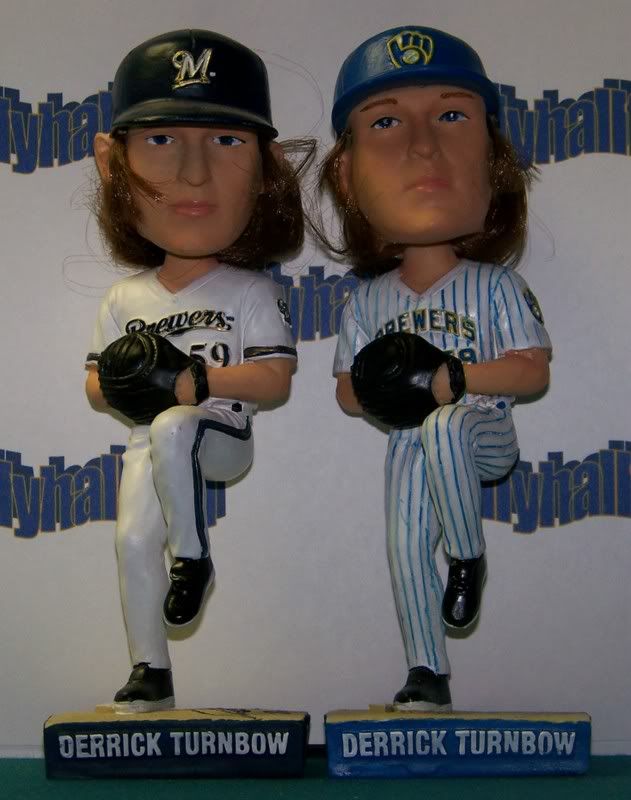
Instead, I will remember it because despite arriving to Milwaukee well in advance of the first pitch, we had underestimated the Dairy State’s fascination with Turnbow, their mulletted closer. That night was Derrick Turnbow bobblehead doll night, with his mane being immortalized with actual glued on hair. It was particularly ironic that he should come in to take the loss in a tie game in the top of the ninth inning, but as I noted, players often suffer bizarrely poor performances on bobblehead nights in their honor for no apparent reason. As Feiny facetiously pointed out, “Babe Ruth died on his bobblehead doll day.”

The demand for this particular promotion was so strong that we struggled to find parking anywhere near the stadium and eventually put our car next to Deek’s in a vacant lot next to a McDonald’s which sat down the road from the stadium. The five of us didn’t enter the turnstiles until the sixth inning.

I probably should have assumed ahead of time that the entire state of Wisconsin gets in gear when there are limited edition free nodding statues in the mix. The stadium’s attendance that night was well in excess of its seated capacity, as the up-and-coming Brewers – they would reach the postseason two years later for the first time since 1982 – proved a strong draw. Doubly so on promotional nights. I would leave the park satisfied considering the Mets won the day, but I would be lying if I claimed to be calm and relaxed throughout the entire course of trying to find a parking spot. This irritation was only worsened when I found that Deek and Feiny decided, despite the game already being five innings old, to actually go into McDonald’s after parking. Fortunately, they were so hungry that they managed to scarf down their food as we walked to the building, picked up our tickets and entered a mere 2/3 of the way through the game.

But we did get our bobblehead dolls – and in the limited edition throwback uniform to boot.

Zach in the meantime felt the need to overcome whatever stress he was recently enduring by drinking a lot of beer. And quickly. Two innings after we showed up it was very clear I was going to be driving home as Silka was in no condition to do so himself. Considering we only got to watch three innings of the game, the amount of time for him to sober up was practically nil. Zach had also convinced us to divert from our original plan of spending the night in the party town of Madison because Deek and Feiny broke it to him that at this point of early May, most University of Wisconsin students were studying for finals or home after finishing them.

The inebriated Silka convinced me we must drive back to Evanston for a party that wound up never happening, and after he told a number of Mets fans at the stadium that he was from Syosset, New York instead of his actual hometown of Toledo, Ohio, Zach quickly passed out in the back of his SUV as I guided it back to Evanston. Halfway through the ride Zach woke up and told me we absolutely had to pull off at the next hotel so he could use the bathroom. This required going through an unmanned tollbooth, which we shockingly didn’t have enough change on us to pay for. As Zach threw pennies in the bucket and insisted we go through anyway, I stopped at a hotel where he calmly went inside to ask the front desk where the rest room was.

A few minutes later Silka emerged. Rather than walk to the car he casually strolled around the side of the building and relieved himself behind a dumpster. Evidently they wouldn’t let him use the bathroom inside. It seems strange that my strongest memory from visiting Miller Park might be seeing my roommate get turned away from a public rest room, but knowing the zaniness of that entire night, it sort of makes sense.

And knowing what shape he was in, well, I can’t say I blame them.